Yeah, I never understood what Beyond's core innovation was. Impossible had that whole synthetic heme thing going on. Beyond seemed almost like opportunistic mimicry. But Impossible turned out to be pretty expensive IIRC.
In my opinion as a mostly-vegetarian who used to adore burgers as a kid, the Impossible brand was by far the most realistic (and my beef-loving partner would agree, they made stroganoff with it and loved it)... but the price truly is ridiculous at this point. It started out just barely justifiable, and it's simply too high now.
I am more than a little bit outraged that animals who were raised in miserable industrial production facilities to meet an ugly end are having their parts sold for less than a decent alternative simply because of subsidies distorting the market.
If I look at walmart right now, they have Impossible 'ground beef' for $9/lb and real ground beef is more than $7/lb. So the price isn't too high everywhere.
Agree. Impossible is on a different planet in terms of being very very close to the taste of real meat. Unfortunately still premium priced.
It’s a pity that Beyond is getting so much attention because they’re not the best ambassadors for meat alternatives. People will try it, and then decide to wait another 5 years before trying again.
Beyond was available well before Impossible was. I used a combination of Beyond and Boca as my primary substitutes for ground beef, until Impossible came along, and now I use almost exclusively Impossible.
I don't feel like they have a niche anymore, but there was a time I considered them my top choice, before impossible dethroned them.
I still eat impossible sausage as a substitute for pork and find it pretty dang good. I grew up in appalachia so we know our pork sausage and impossible seasoned well comes close.
Aldi in Germany might be very different for all I know, but I've been vegan or vegetarian my entire adult life and I think every burger alternative besides Beyond/Impossible is quite awful, though I usually don't eat meat alternatives in the first place.
The key difference between the old vegans and the new vegans is hiding in plain sight. It's the Internet. It used to be that vegans went to vegan restaurants and had their own particular tradition of vegan cookery. People didn't just become vegan in isolation like they do today. The acculturated vegans still exist and I think that's who gp is referring to in that statement. The Internet vegans are different but they aren't that numerous — few people even today would make such a change in their life based on something they read online.
Despite being a vegetarian and former vegan, this is not me wading into this debate to defend the figure provided by the OP of the original comment, but this is usually the source for the statistic AFAIK: https://scet.berkeley.edu/wp-content/uploads/CopyofFINALSavi...
Regardless, it goes without saying (from other, more well-sourced research) that the disparity of subsidies and government assistance provided to industries that ultimately exist to produce meat compared to industries that produce fruit/vegetables is fucking absurd.
I'm struggling to understand the point you're trying to make well enough to know how to respond, other than to say vegan cooking traditions continue to exist and existed before the internet (though there were fewer vegans at the time)
People did indeed become vegan in isolation before the internet, just as they do today.
What exactly is the distinction you're trying to draw between "old vegans" and "new vegans", and how do you see it pertaining to this conversation (especially under a comment pointing out that plant-based burgers struggle to compete with traditional beef because of beef subsidies)?
Yeah, I generally think people make adult diet choices on their own.
People regularly cut out meat, alcohol, sugar, dairy, gluten, caffeine, fats, etc. based on things they’ve read, moral considerations, medical recommendations, and personal health observations, not because they’ve joined a community that eschews such things.
For one thing, it's fairly uncommon for children to purchase operating systems. As long as there is one major operating system with age verification, parents (or teachers) who want software restrictions on their children can simply provide that one. The existence of operating systems without age verification does not actually create a problem as long as the parents are at least somewhat aware of what is installed at device level on their child's computer, which is an awful lot easier than policing every single webpage the kid visits.
So I agree that operating systems and device developers should not be liable. That's putting a burden on an unrelated party and a bad solution that does possibly lead to locked down computing. I meant that liability should lie with service providers. e.g. porn distributors. The people actually dealing in the restricted item. As a role of thumb, we shouldn't make their externalities other people's problems (assuming we agree that their product being given to children is a problem externality).
>The attacks, seen in videos circulating on social media and verified by The New York Times, appeared to be the first on Iran’s energy infrastructure since the United States and Israel launched strikes on Iran last weekend.
Hey, FLASH finally hit Hacker News! I remember my professors talking about this in graduate school. It's a fairly well-established effect: the tumor selectivity of radiation is much better at ultra-high dose rates. It is still unclear exactly why. But there are a lot of studies about it:
I was starting to infer there was a better focusing ability so it could start and exit as a broad cone of radiation and keep the peak intensity at the tip of the focal cones at the tumor-tissue, and the short pulse also helped the healthy tissue.
But the way this sounds, it's more like a straight beam delivering similar intensity to healthy and tumor tissue but the biological effect strongly differs between healthy vs tumor tissue?
Yes, the radiation dose under the conventional metric (energy divided by mass) is the same, but the effects on biological systems change. I included a little speculation on the chemistry in my response to a sibling comment.
My guess would be that the radiation doesn't itself care but that tumors have some other characteristic (like multiplying rapidly) that makes them more susceptible to it. Similarly to how you can sometimes attack them with medication that inhibits cell division.
Yeah that's the conventional dose rate effect, not the FLASH effect. The FLASH effect happens on timescales so short that ordinary considerations like the cell cycle or DNA repair mechanisms are inherently ruled out. Instead it might have to do with the type of radical species that form in normal cells versus tumors, possibly related to oxygenation, pH, glycolysis byproducts, etc.
The first interaction of radiation with tissue is usually this:
H2O + ħv >> H2O+ + e- (fugitive)
The radical ion H2O+ is extremely reactive and usually protonates another water molecule immediately:
H2O+ + H2O >> H3O+ + OH*
The hydroxyl radical has a half life of about a nanosecond and will usually be the main "reagent", diffusing until it runs into an organic molecule which will be oxidized and thus degraded. At high enough dose rates, the peak concentration of hydroxyl radicals and more stable radicals like superoxide could be much higher, leading to "nonlinear" effects, i.e. byproducts of multiple radicals interacting with each other or a protein.
One thing I found confusing about the nature article is that it mostly discusses conventional linear accelerator + bremsstrahlung X-ray radiation versus very high dose rate FLASH in the form of electron beams, proton beams, or even carbon ion beams.
Do we know that what the chemical mechanism for damage from charged particle beams is? Is it similar enough to compare directly like this? Are the timescales short enough that charge deposition might matter?
The article is a bit unclear, but we have both a very wide range of X-ray vs charged particle studies, and increasingly of conventional vs FLASH studies with a range of modalities (e.g. the seminal FLASH paper was FLASH electrons vs conventional electrons). FLASH photon vs conventional photons are also increasingly being generated, although they've been more of a pain to generate.
So it's clear there is a temporal FLASH effect, which is not purely a question of radiation type.
That's not to say it's necessarily exactly the same effect - we still don't have a perfect quantitative understanding of the effects of different radiation types even at normal dose rates, let alone when FLASH differences are added into the mix.
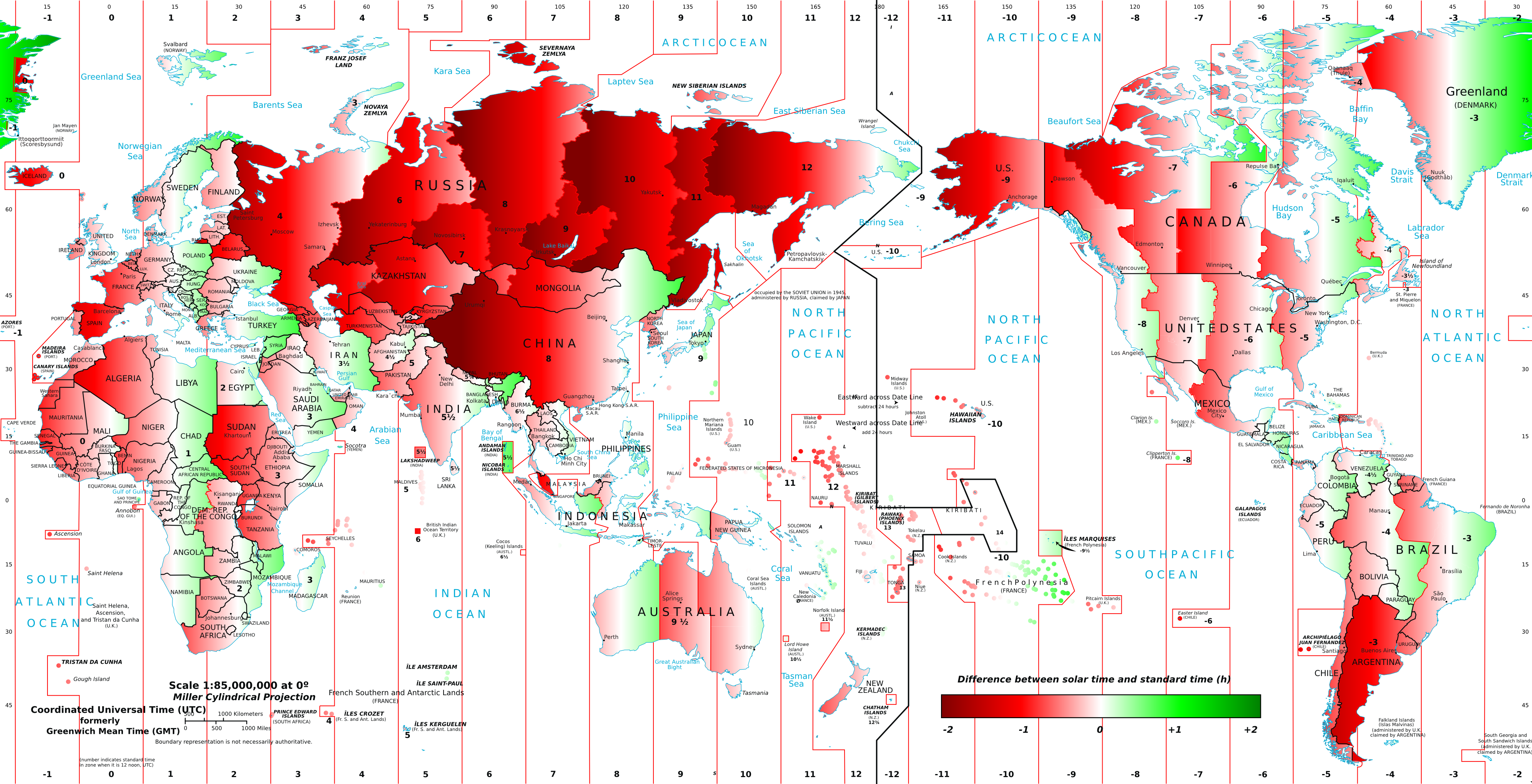
Thankfully, this is a situation we don't need to speculate about without evidence. Spain is on de facto permanent DST, serving as a natural experiment. I bet the results support you.
That's partly because it's in the same timezone as Poland. Madrid is further west that London, but London is an hour behind. Moving Spain to permanent DST puts it on the same effective timezone as London.
The clocks should show 4:45PM in Spain if the TZ was right (same as UK), and even so it would still be mostly red-white with barely any green. Poland appears white-green in the map, to have a bit of red it should be in a 1/2 TZ like India.
Minimum daylight (winter) in Warsaw is 7h 42m [0] and in Madrid 9h 17m [1]. Maximum (summer) is 16h 47m and 15h 4m. That is due to latitude and unavoidable. The exact numbers for sunset and sunrise are pushed around by the TZ choices.
Most of the world tends to prefer to not be too far from the center of the timezone (where solar noon matches solar time in standard time). Geographic and political boundaries make it so that often it's more red. The extremes of north and south tend not to care as much because it doesn't matter as much.
I don't think that explains it. The "red" offenders are basically Russia, China?, Sudan, Argentina and Alaska. The only "green" offender is Greenland, which is still large enough to enough red to justify it. I get China, it aligns with the population density. Sudan likely wants to have the same time as Somalia and Ethiopia. Why Argentina? Why Alaska? And why does Russia basically have zones that range from +2 to the +1 offset? They don't even have the excuse of avoiding 2 hour jumps like between Alaska and Canada, because they still have that.
Argentina is https://en.wikipedia.org/wiki/Time_in_Argentina - My speculation would be that Argentina (the east coast especially) wanted to be economically synchronized with the coastal cities of eastern Brazil. Buenos Aires and São Paulo being on the same timezone makes it easier for the two of them to do business.
Alaska used to have four timezones. In 1983, they were consolidated into two timezones - Aleutian and Alaska. Being in -9 rather than -10 brings Anchorage closer to the Pacific west coast in its business day with the note that it doesn't matter too much when solar noon is if sun is up for 22 hours or 5 hours.
Spaniards are a lazy bunch of party animals, waking up late and going to sleep late too...
Or the clocks are wrong. Once you realize noon is 13h in winter and 14h in summer, never 12h, things start to make sense. Late lunch? Not really, Sun at same height than Italy, but clocks off by 1.
For the "public image" part of the experiment, the conclusion is easy: bad. Time to change clocks so waking up happens at "3h" in the morning, and become a country of hard workers with no nightlife, because everyone retires "early". Even if discos are full as in the past.
It's crazy to me that we want to force age verification on every service across the Internet before we ban phones in school. I could understand being in favor of both, or neither, but implementing the policy that impacts everybody's privacy before the one that specifically applies within government-run institutions is just so disappointingly backwards it's tempting to consider conspiracy-like explanations.
The advantage, I think, of age verification by private companies over cellphone bans in public schools is that cellphone bans appear as a line-item on the government balance sheet, whereas the costs of age verification are diffuse and difficult to calculate. It's actually quite common for governments to prefer imposing costs in ways that make it easier for the legislators to throw up their hands and whistle innocently about why everything just got more expensive and difficult.
And the argument over age verification for merely viewing websites, which is technically difficult and invasive, muddles the waters over the question of age verification for social media profiles, where underage users are more likely to get caught and banned by simple observation. The latter system has already existed for decades -- I remember kids getting banned for admitting they were under 13 on videogame forums in the '00s all the time. It seems like technology has caused people to believe that the law has to be perfectly enforceable in order to be any good, but that isn't historically how the law has worked -- it is possible for most crimes to go unsolved and yet most criminals get caught. If we are going to preserve individual privacy and due process, we need to be willing to design imperfect systems.
The argument about luminance ranges is wrong. I measure the brightness of monitors regularly as part of my job, and typical maximum luminance values are in the range of 100-500 lux. That puts you right in the steep range of the visual response (especially if you are turning it down and near a max of 100), which is natural — maximizing the slope of the neuronal response to light means that more information will be available to the brain. In fact a good monitor will be tuned according to the just-noticeable difference which aims precisely to maximize the information available according to this characteristic curve. See e.g. the DICOM standard:
The author's basic problem is that he knows too much about the brain and not enough about monitors.
The author goes on to argue that you should be turning your brightness down, but most people already are turning their brightness down; the blue light filter is more comfortable. He does make a reasonable case that you should be reducing green light similarly, but people prefer the incandescent effect of the flux filter to a straightforward color filter — indeed a primary design goal of these filters has been to be pleasant to look at which is why people use them.



reply