A lot of folks here are calling out the lower pay for SWEs in Europe and Canada as a failure - but also praise the low wealth inequality and low income inequality in Europe and Canada.
You can't have low inequality by definition if you decide to start paying one group a ton of money.
Well, this is a lot like the housing conversation in the US. "I want my house to go up in value, and be a great investment!" Also: "Why can't I afford a house?"
You can't have your cake and eat it too.
It's not necessarily a failure, it's just a different place to draw the line on social contract. While individual contributors earn less the social safety net also makes it much easier to found and grow a business without the threat of death and guarantees a peaceable minimum standard of living. It's also worth pointing out that salary, especially at high seniority levels, becomes a smaller and smaller part of total compensation.
Paying laborers more does not lead to the kind of inequality we see.
"You can't have low inequality by definition if you decide to start paying one group a ton of money."
Very few of even FAANG-level salaries are high enough to put them in the same bucket as the people who wield power through their wealth. Paying the entire field of SWE laborers even 50% more salary is not going to appreciably change the inequality gap.
Are you sure about that? Sure, not the top elite, but there's still a significant gap between upper middle class and lower in for example Sweden, which I believe is one of the more equal countries. FAANG level salaries would significantly widen that gap.
Agree with this take, being in the upper 10% of salaries in Sweden gave me perspective on how wide of a gap there is between myself, some friends working other office jobs (accountants, architects) and some in more blue collar work. I don't feel like I deserve a much higher salary than what I have for this society, I'll be honest and say that sometimes I feel ashamed of earning so much more than some friends given that my job isn't really that important for society.
Oh yes, familiar. I'm in Sweden, I definitely make good money by Swedish standards, and also have excellent benefits through work. This is, frankly, not proportionate to the value I provide to society. I work on some nice software that certainly adds convenience to the lives of many people in multiple countries. But it's by no means critical, and I generate less value for society than anyone working in healthcare, than competent teachers, and than many other workers who make significantly less.
Plus my job is safer and more comfortable than many others. I sit in my office, I think and I type. Unlike the emergency services, I don't risk my life or health, nor does anyone's life depend on my work. Unlike construction workers, assembly line operators and many others, my office environment is free of hazards.
Your salary is not about value for society, it's about value for your company.
Software as they say is eating the world. The software you write replaces tons of manual processes generally. Finally it come down to supply and demand. If lots of people know how to program (well) the salary goes down.
You should never feel embarrassed by making a good wage. If you wish, you can always use that wealth to give back to society and your community.
Being from the Netherlands, I recognize this shame. High positions in the workforce are often shamed, talked about as "easy money", as if it's inherently corrupt, people don't acknowledge their risks and responsibilities. Whether that warrants those high salaries or not, I'm not commenting on that debate. Public functions or private organizations in which the government invests, must cap salaries at what the prime minister makes, which is "only" around 200k euros, a fraction of what american CEOs make. This includes public television talent; imagine your US network television nightly news anchors being capped at 200k. (I understand those are private, just making the comparison because they're the highest watched shows in either nation. Private television in the Netherlands is not subject to the cap, but also has not the highest ratings.)
Now that I live in the USA, I've never heard anyone talk like that about a successful CEO. Envy yes, aspiration too, admiration yes.
And yet Netherlands has the highest wealth inequality in the world (https://en.wikipedia.org/wiki/List_of_countries_by_wealth_eq...) so one could interpret this cap and the cultural attitude you described as pretty much a scam by the capital owning class to maximize their returns.
Yep. I also never understood why Europeans focus so much on income inequality ("OMG, programmers and managers get paid too much, tax them more!") and not wealth inequality where old, established families can keep rolling their wealth from generation to generation nearly tax-free and see their assets apreciate substantially while the working class bares the brunt of taxation and are getting squeezed every year more and more by wage stagnation and inflating real-estate prices.
It's a real mystery to me why people aren't up in arms about wealth inequality instead but I guess as long as the working class is provided with a minimum of comfort (food, shelter, healthcare, education, sex) and are kept busy with the ratrace for the next big career move during the day and with an endless stream of available entertainment and consumerism in the evening, they're too busy to notice, care or bother to do anything about it.
Yes exactly. People get up in arms about things they are told to get up in arms about. Many people either don't know how much of Europe's wealth is concentrated in old families, or don't care because they're not told to care.
For example, BMW. It is simply ugh. At least with US companies you know they'll do right by shareholders for better or for worse. If you invest in a German company you might as well be pissing your money away because they'll always do what's right for the heirs.
> It's a real mystery to me why people aren't up in arms about wealth inequality
You have quite a few Dutch political parties talking about this, PVDA, The green party, the socialist party etc. The socialist party (SP) actually suggests giving all employees shares in the companies they work for. But these left wing parties, while not unpopular, have the whole ultra capitalist system working agaisnt them. What can the SP do if their legislation simply causes business and the rich move to another company? It's an impossible battle. You need international cooperation for it to work, and there is no such cooperation.
That's one of the saddest things about extremism. People get disenfranchised by their existing leaders. Then they are desperate for new political blood because they don't understand the underlying problems. Clueless people who promise exactly what you want to hear start leading parties and fight the wrong battle.
Income inequality is driven by wealth inequality. The wealthiest people don't get compensated in dollars, they get compensated in equity and if that equity is going up, companies can afford to pay more to their executives.
Wealth inequality is driven by domestic economic demand shifting away. It is either concentrating in a few economic hot spots (urbanization), moving to other countries (globalization) and through central bank money that sits around in asset markets. There are probably lots of other factors but they are increasingly less impactful.
Urbanization is not necessarily a bad thing if there is enough housing and people can move to the new location, except not enough housing is built and existing residents hate the new arrivals.
Globalization is not necessarily a bad thing if it also drives foreign demand. Turns out, the Chinese really love buying foreign real estate but nobody is building the luxury apartments they want. So they have to buy less luxurious housing and drive up prices in the middle and affordable segment of the housing market.
Central bank money is not necessarily a bad thing if the money is used effectively. The government can help the economy by providing cheaper funding to companies during bad years when there is lots of work to be done. But what if the economy isn't in a bad year and merely refusing to grow? It means that there is already enough funding but not enough demand for services and workers. In that case you also have to apply the government stimulus on the demand side as well. But that's not what central banks do. They can't do it by definition because that's not their responsibility. The central banks are separated from the rest of government because the government can just abuse it's money printing powers to fund endless debt and cause hyperinflation. However, when it's the central bank that is doing the endless printing people don't seem to care, somehow most economists care even less and will assert that even moderate demand side stimulus will eventually lead to the slippery slope of hyperinflation.
Ultimately history will just repeat. A war is a quick and easy way to get rid of excess workers. It is also a quick and easy way to provide demand side stimulus in a political environment where more sensible options are considered impossible. It's like political capital is like money. Once you have run out you are going to be extremely desperate and are willing to do anything no matter how stupid. Running out of political capital is the reason why Keynesian gold digging is even a thing in the first place. All good options have been exhausted, anything that follows is batshit insane but it is also the only thing that can be done.
Well taxes on the rich are not low in NL, so it's not a scam. The current asset bubble just distorted everything in a bad way, and finding new taxes on wealth is hard since wealth flees very easily.
But I agree wealth inequality should be talked about more than income inequality.
British, for contrast. I attribute most of my success to luck. I was born with aptitudes, in a stable family, white male. I'm definitely not worth what I'm paid from a societal point of view. I find the idea of being multiple times the median wage for chilling in front of a computer solving puzzles bizarre.
The idea of talking about money is slightly awkward anyway, and I guess I'd say embarrassed rather than ashamed? Different culture and motivation, but a datapoint for you :)
The wealth inequality gini coefficient is not very useful and misleading. You could have a country where people choose to take on debt when they are young, and all of them end up with the same higher level of wealth later in life. This would be a very equal society, but could have a very high wealth inequality gini coefficient. To actually judge the wealth inequality of a society the analysis should be done cross-sectionally, comparing within age cohorts. [https://www.sv.uio.no/esop/english/publications/articles/201...]
Yes, I am quite sure. The typical FAANG developer is not earning $200k base and $200k RSUs per year. It's more like $130k - $180k and maybe $80k to $150k RSU. You have to be pretty senior to reach top 5% income at FAANG in the US--it isn't as common as HN would have you believe.
There's a gap between FAANG and, say, a janitor's salary; that's just not debatable. The gap is much smaller than between Mr. FAANG and Mr. Top 5%, and for all intents and purposes Mr. FAANG is Mr. Janitor when compared to Mr. Top 1%. That some FAANG employees are in the top 1% doesn't negate this.
I guess it all comes down to which unequality we're talking about. Sure, if does not significantly affect the difference between the very top and the rest. But there are a lot of differences between different brackets from the ones at the bottom up to 99% too.
Those differences between the lower brackets exist more because of the power those in the top have. Raising incomes of those in the lower brackets might increase the gaps between some of them: but those gaps are much smaller than between any of them and the top.
They do? How can you be so sure there are causation between the two? Lessen the gap between the 99% seems to affect the general consensus (since 99% share a more similar type of life and experience status /money wise), making it easier to change the rules for the top 1%.
To me this feels like falling into perfect is the enemy of great trap. Just because this topic might be affecting you (assuming you're a software dev), and because it doesn't affect the top 1%, doesn't make it smart to widen the gap between the 99%.
Not really true. Being a dev in sweden does not put you in the mid-upper class (lawyers, doctors, footballers, celebrieties, bankers, management consulting)
In Ireland, software developers with similar levels of experience earn significantly more than doctors, lawyers, management consultants and most bankers. There's only a tiny number of footballers, celebrities, bankers, and non-software consultants who earn more than the software developers as a class.
I like Germany for an example. The top tax bracket (Spitzensteuersatz) is 42% and is reached when you earn a laughable 57k€ a year, something that will never allow you to afford an apartment in a city for a family. The next higher tax rate is 45% for income above 279k€ a year (Rich tax). Source: https://einkommensteuerrechner.com.de/Steuersatz.php
And then the German finance ministry keeps trying to squeeze blood from the turnip even further every year by dreaming up new taxes, while actively discouraging investing (Olaf, the finance minister, claims not to invest in the stock market and keeps his money in a savings account while at the same time pushing negative interest rates) with Transaction taxes and no tax-advantaged savings account. You could consider that maybe conservative Germany encourages investment in real estate. Nope, you get to pay 6% sales tax and 1% notary fees when you buy a home, with no breaks for first-time home buyers, and you can't write the interest off on your taxes either.
Ireland does not have low taxes for individuals compared to continental Europe.
Even compared to Sweden, personal taxation is comparable for high-earners, although Ireland's much more progressive and redistributive scheme results in lower taxes for low-earners, and thus a smaller tax base.
I can tell you that I’m a not terribly highly paid software dev (by US standards) in Ireland and my marginal tax rate is about 50%, and it could go up a few points if I made more. Add 40% tax on cap gains as well. And bank interest. (I get < 1 eur a year in interest, and they send 40% of it odd to revenue. Why bother? Hell if I know.)
Hmm, it's anecdotal, but my colleagues who moved from Ireland and UK to Austria say that back there it was basically a tax heaven for tech workers compared to the income taxes they pay here so... maybe you could be wrong?
Ireland is bang on the EU average for taxation of high earners. It seems Austria has higher (although not massively so) taxation of high earners - source below.
Ireland has the most progressive taxation system in the EU, so low-earners do indeed pay less personal incomes taxes than any country other than Cyprus and Estonia.
Ireland is definitely not a tax haven for tech workers - you're the only person I've ever come across to hold that opinion. The UK may be closer to that, as self-employment is much more attractively taxed there than Ireland.
Based on my insights (I'm actively recruiting software engineers, my dad used to run a health clinic as a doctor, I'm educated and have many friends within management consulting - in Sweden) that's at least not true for doctors - at least it's in the same ballpark (in contrast with FAANG-level salaries).
Marginal tax rates are much higher in Europe at lower levels, so in order to pay someone 50% more, you would have to pay them 100% more for them to get a 50% pay increase to make up for the money taken by taxes (the mechanism that prevents wealth inequality)
False, this mechanism only prevents income inequality but not wealth inequality as existing wealth is not taxed much in Europe.
For example, inheritances, assets and properties are not taxed much in Europe (people scream double taxation if you propose that) but income is taxed substantially so you'll never be able to save enough to catch up to the upper classes who own assets.
So actually, in some European countries, while having low income inequality because of high income taxes, you end up with huge wealth inequality due to untaxed inheritances, assets and overvalued properties rolled over across multiple generations to the point where Germany's top 10% own two thirds of the country's wealth:
To level the playing field and reduce wealth inequality, a sound policy would be to tax income less and tax inheritances and assets more but fat chance of that ever happening as that would be a blow to the ruling class.
This comment makes the mistake of treating Europe like a country, which it is not.
> For example, inheritances, assets and properties are not taxed much in Europe (people scream double taxation if you propose that) but income is taxed substantially so you'll never be able to save enough to catch up to the upper classes who own assets.
In Ireland, apart from relatively small tax-free thresholds (€335,000 lifetime from parent to child, for example), gifts and inheritances are taxed at 33%.
In the UK, above its (similar) threshold, the rate is 40%.
The US Federal Estate tax rate is 40%, but with an enormous $11,580,000 estate threshold, which is orders of magnitude higher than Ireland or the UK.
Even though Ireland and the UK have some of the highest inheritance taxes in the world, the EU effective average is still ~14% - double the global average of ~7% and on par with the US, where added State taxes vary the average between 12% and 19%. Source: https://www.uhy.com/uk-imposes-highest-taxes-on-inheritance-...
>This comment makes the mistake of treating Europe like a country, which it is not.
Of course it's not, never said it was but cherry picking countries with larger inheritance tax is also a mistake as you can't choose where you pay your taxes as an EU resident. You pay them where your main residence is.
So on the other side of the spectrum you have Austria which has high income tax (because socialism and income equality) but basically no inheritance taxes, and taxes on assets are levied on their original purchase price so you end up having countless residents who earn small incomes but are sitting on millions of euros of wealth due to exploding real estate values but only pay 5 Euros tax per year as that's levied against the purchase price from 60 years ago when their grandparents bought it for pennies.
So you end up with huge wealth inequality where even people with good incomes pay high taxes and are priced out of the real estate market if they don't come from families of means.
I didn't cherry pick anything. I chose the UK and Ireland as they directly contradict your statement that:
> False, this mechanism only prevents income inequality but not wealth inequality as existing wealth is not taxed much in Europe.
The E.U. is home to both the highest and lowest inheritance taxes in the world, and averages very close to the US. I think this adequately refutes your statement that "existing wealth is not taxed much in Europe."
I play an economic simulation game. Every time I see an asset explode in price (inflation) I am thinking "I should get into this industry and produce the stuff that is going up in price". High housing prices are a strong demand signal, meaning more houses should be built. It's really unfortunate that it does not happen enough.
Because it's not the building the houses that's the tricky part, that is easy, it's the land that's expensive and difficult to obtain. That's what's appreciating since it's a finite amount, not the walls and roof sitting on it.
The problem with inheritance taxes is that there are some crazy people who believe that the tax rate should be 100%.
There is also the big issue that you can just transfer most of the wealth well before death.
If I were to suggest an inheritance tax it would not be significantly higher than 30% but it should have a generous tax exemption for at least $10 million.
However, I personally do believe not that this is an effective solution against wealth inequality because it is a very slow mechanism. It would make more sense to just raise capital gains taxes and decrease dividends taxes so that there is no longer a heavy skew towards wealth building in the first place.
You can still get returns but they have to be paid through a dividend which generally correlates with useful economic activity. You can't just flood the market with cheap money and then use the cheap money to pay dividends if you didn't earn the income in the first place.
Borrowing money doesn't increase the value of a company. It is neutral. If the company is spending that borrowed money on dividends then the company is losing value by exactly the amount that is paid out.
That's more or less true in the U.S. too, at the rates software engineers make, at least in NY and CA. In my locality a software engineer making $100k will face a 40% marginal tax rate.
40%?! Where do you live? The effective federal income tax at 100k is 22.75%. I don't think any state has a 17.25% effective income tax, certainly not if you only earn 100k.
If you're making 100K in California, your marginal tax rate is:
- Federal: 24%
- State: 9.3%
- FICA: 7.65% (6.2% social security, 1.45% medicare)
- SDI: 1%
This gets you to 42%. Your employer matches the FICA payments too, so that's closer to 50% of your take-home pay.
Once you make enough to pay off the regressive FICA taxes ($142K) you get bumped back down to "just" the mid-high 30% range briefly, until you hit $163K, then its back up to 40% again.
In many developed countries, 42% tax would cover healthcare, a pension you can actually live off of, and fully-paid education for all of your children. Californians get none of those things, and I don't really understand what it is that they get over (e.g.) Washingtonians for the extra ~30% in taxes.
In the states, tax is obscure but painful -- you feel it when you pay it, like a sales tax not included in the price or a complicated tax form. In Europe, tax is hidden but smooth -- like a VAT built into the cost of everything or a 3-box tax form (in NL)
They get protection by the US military and promotion of Californian business interests throughout the world through Federal institutions. Not to mention: friction free access to a large labor pool and US domestic market etc.
I get your point that the US doesn’t provide as much social services as other developed nations. Almost all these nations depend on US hegemony to not have to spend as much on their military. This is a choice that the US made. There are good arguments for scaling back military spending and increasing social spending without compromising US hegemony though, however those choices may not be politically expedient so here we are.
I don't want to address the hegemony point beyond I disagree on the need or even effectiveness of US military.
But I would want to point out the curious phrasing and of your first paragraph and what that says about USA way of thinking. All these points are business targeted while all european points are individual targeted.
> But I would want to point out the curious phrasing and of your first paragraph and what that says about USA way of thinking. All these points are business targeted while all european points are individual targeted.
I don't think there is anything curious about this way of thinking. And US hegemony plays directly into this!
Pre-World Wars, European nations had their colonies and their militaries and the priority of thinking was along similar lines: access to expansive markets, large pools of labor, protection of business interests etc, chiefly through colonies.
WW2 changed all of that, reducing European nations to client states (no disrespect) of the US, that funded their reconstruction. Colonialism was no longer allowed, and European nations could not freely pursue foreign markets without competing with US companies, which would always get precedence. With no real way to compete with the US militarily, and with NATO aligning with their immediate geo-political needs anyways, European nations invested heavily on Social Services, rather than blow up their military budgets. This geopolitical equation hasn't changed post WW2 and you have generations of people that consider social services as the primary function of their Government.
However, its a fundamental mistake to assume that a Government can provide effective social services without having a strong economy. Strong economies require successful businesses.
> However, its a fundamental mistake to assume that a Government can provide effective social services without having a strong economy. Strong economies require successful businesses.
Umm... I would say the social services in european countries are pretty successful.
It can depend on what to compare them to (and for what class, which changes a lot in terms on access to commercial clinics, etc.). What countries are you comparing to?
I can get into the nuances of it, but honestly even on surface level, just the single point that my Health care is not linked with my job gives me infinitely more control over my life.
WA residents get all of these things with 0% state tax, and only a bit more in property taxes. What Californians get for the extra taxes (and Washingtonians too, for that matter, for a large fraction of theirs) is a jobs program for incompetents that occasionally achieves something good as an unintended side effect; known as government.
I frankly have no idea why US govts on all levels, and from all parties, seem so much more incompetent than many European/Asian ones (I have a pet theory), but they are.
> They get protection by the US military and promotion of Californian business interests throughout the world through Federal institutions. Not to mention: friction free access to a large labor pool and US domestic market etc.
And Washingtonians do not? What you wrote does not address the question that the parent poster asked.
If you have children, you lose out on child benefit between 60k and 70k, which adds an equivalent 10% in that margin.
Between 100 and 120k there is also the loss of personal allowance, which results in a marginal tax rate of 62% in that bracket. If you have children between the ages of 3 and 4, you also lose out on 15 hours/week childcare, resulting in that marginal tax rate hitting 89%
I don’t view paying my own individual debt as a tax. I have a percentage of my pay deducted and diverted to my retirement account. That’s not a tax either, even though it’s percentage-based on my pre-tax amount and directly deducted.
You can opt out of your pension contributions. You can’t opt-out of paying student loans, which is an available option with other debts.
Student loan deductions reduce a balance that doesn’t impact your credit score, can’t chase you for repayment (unless you do something stupid like move country and fail to inform them) and doesn’t impact lender decisions. Most people have no hope of repaying their ‘loan’ in their lifetimes and instead expect the loan to be written off after 25 years. U.K. student loans being debt is a technicality, it’s a tax with a countdown timer that might be shorter if you’re baller.
You aren’t wrong, but hitting 6 figures at age 30 is very far from the typical experience. Outside of London it’s not guaranteed you’d even hit £60k.
Plan 2 students are screwed, with the high interest rates and slower repayment schedule I wouldn’t even be sure non-London devs would finish paying it off.
In Croatia the total would be about 63%. If you go through capital gains (no paycheck just profit after corporate tax, capital income tax and VAT) it's 53%. It could go down if some company expenses can be used for your life expenses.
In Austria the total is 75%. In Austria going through capital gains would still be 70%.
I'm very disappointed at how much money Europe sucks out of my work.
"Capital gains" through GmbH is 25% KÖSt (Körperschaftssteuer) and then 27,25% KESt on Profit. The highest VAT rate is 20%, there are also lower ones. This results in 56.35% percent including VAT (1-((1-25%)(1-27.25%)(1-20%)).
If you go through income tax as a freelancer this is even lower when you claim the default deductibles (Pauschalierung), which is common in IT jobs, because you have very low expenses. The later is also cheaper if you factor in health insurance.
Well, having a GmbH does not really allow a clean profit extraction without having employees, so when you eventually employ yourself you'll get to around 70%.
Austria is one of the worst countries in the world to do any kind of small business. Self-employment is also taxed aggressively.
A form of self-employment in Croatia allows a fixed tax payment of about 5k EUR a year with an income cap of 39k EUR per year, leaving you with 34k EUR after taxes. Similar thing in Serbia but even more money.
In Austria there's nothing like that.
It would be nice if it was possible to assign a significant amount of life expenses to business but that also is heavily bureaucratized and regulated that even buying a 5k EUR computing machine has weird tax consequences (not immediately deductible as expense in the full amount or now, because expenses are higher, you might not be able to take that 12% of profit untaxed).
I mean, I guess I'm just miserably following every word of law and my accountant's advice and maybe other people just ignore a bunch of these guidelines and hope that inspection never comes.
39k EUR a year in Austria is 33% tax+insurance+pension:
20% "forced savings" (Pension + Vorsorgekasse)
7% health insurance
6% income tax
But 39k a year is definitely not a freelance programmer in Austria.
80-120k is the average I see at my colleagues and enterprise customers for freelance programmers with regular working hours compared to regular employees (5 week vacation, sick absence, ...). I know people scratching at 200k, but they are senior consultants.
So a more realistic view would be 100k 40,5% tax+insurance+pension
15% "forced savings" (Pension + Vorsorgekasse)
6% health insurance
19,6% income tax
This calculation assumes that you do not really have significant expenses of business. Having those actually makes the picture look worse.
You can calculate here for yourself, no "cheating" required:
https://abrechnen.wko.at (official chamber of commerce calculator)
A GmbH is always better at 220k+/year. But there may be reasons you would want one earlier (liability, employees, IP, investments, ...)
Employing people in Austria is expensive ("cost of labor"). Beeing self employed is not bad, if you factor in benefits and costs of life and quality of life.
Well, 34k after taxes in Zagreb, Croatia is about 50k after taxes in Vienna. Given the increased cost of living and quite similar bureaucratic and regulation heavy state I'd say the self-employment is very aggressively taxed. For 50k after taxes you need to earn quite a lot compared to 39k in Croatia and the benefits are not that much different.
I do not own anything substantial. Saving for a house in the capital city would take about 15 years of frugal living as a programmer. I could also take a loan.
What I also dislike is the tax prepayments for business owners, which is basically legal theft. The government takes tax in advance and then gives you back the money if you overpaid after about a year. I wouldn't mind this if taxes were low.
Imagine being a business owner and there's a period of irregular income yet the advance tax payment arrives and bankrupts you.
The taxes here are just insanely high and everything is insanely inefficient. Healthcare, education and municipal services.
After moving from Croatia to Austria, it's much worse in Austria, a wealthier country but still, I see all of the same patterns of inefficiency and they are even worse because Croatia can't afford being so inefficient.
This is slightly misleading. The federal tax rate is a tiered system, meaning a portion of your income is taxed at a certain rate and income that exceeds that tier is taxed at a different rate after that and so on.
The federal tax rate is much lower if you account for that.
Yes, but you'd be amazed at how many people don't understand what that means. No doubt it's not true on HN, but a lot of people among the general public seem to be under the impression that the effective rate jumps at thresholds.
Given that in modern economy it's insurmountably more difficult to earn first million than the next ten, 50% increase in SWE salary would give a huge advantage and produce non-linear effects on inequality gap.
There is only so much "richness" you can share. You can't give 400 million american a nice car, a big house with a view on the ocean, 100% organic food and access to top level healthcare and education. Unless you produce those thing at that scale, and some things are by definition not scalable (there is only one "best medical school in the US"). So some people have more power to get access to/acquire those desirable items. And software engineers are often amongst the first in line. If you want other people to have a better access to these, by definition that leads to current "first in line" to loose something.
Giving more money to everyone is easy, everyone was a billionaire in Zimbabwe few years back. That did not make them "rich".
There's quite a gap to be filled between the current US situation and "everyone has a house with ocean view". You might not be able (and not want) to bring inequality to 0, that doesn't mean the current level can't be lowered a good deal with good solutions. And yes, education can scale a lot - it's just that many gatekeepers don't want that. The story of humankind is making exclusive things available for everyone.
As others have pointed out, people don't actually want "a nice car, a big house with a view on the ocean, 100% organic food and access to top level healthcare and education." all at once. They want a "good enough solution". Some of them are fine with an apartment with a view on the ocean. Some of them are fine with a house without a view on the ocean. Some of them want organic food, a lot of people eat junk food or processed food and like it.
This is basically a strawman that you built so that you can easily defeat it.
Think of the most extreme possible scenario. An economy where no human workers are needed and only capital is needed to build robots that are equally good workers as humans. The rich will own a lot of robots and no longer be dependent on human workers. Here is the problem. Since everyone else is unemployed, nobody can afford to buy your products. It is actually possible to get wealthier by giving to those who have nothing in this scenario because although the rich own robots, the robots are effectively worthless if they don't do any work. You don't even have to give that money away for free, you can just lend it out.
Lending doesn't work in existing economies because it is very difficult to get access to capital if you have no money to begin with. It's also a chicken and egg situation because you need money in consumer hands to drive demand which then drives more loans. If you spend your loans wastefully then the money will arrive in consumer hands by mere chance. So in theory if you just print an infinite amount of money some of it will trickle down eventually. That's the idiotic policy central banks around the world are following instead of giving out just (emphasis on just) enough money to get everyone back to work.
>Giving more money to everyone is easy, everyone was a billionaire in Zimbabwe few years back. That did not make them "rich".
There is an easy indicator for when to stop. You can stop handing out money once you have reached the 2% inflation goal.
>Most urban americans live "richer" lives today than the rich did 150 years ago.
This "richness" is also relative: If you own a goat in a village with no goats, you're rich. If you own an apartment in a village of McMansions you're poor.
And let's not mistake comfort with wealth. Just because I have electricity, a WC, a fridge and don't plow the fields like my grandparents did might make me seem rich, but my grandparents owned that land they were plowing while I don't own the "land" I am "plowing" at my comfy deskjob, but the corporation does, nor do I own the land I live and sleep on, but the landlord/bank does.
Our lives are now much more safe and comfortable than 150 years ago, but in the end, most of us who are not asset owners, are set to be serfs for life, just like 150 years ago except that instead of being serfs to a crown we are serfs to banks and publicly traded megacorps.
There are roughly 350M inhabitants, but only about 120M households.
If you want to give everyone a house with a view of the ocean, with plots 10m wide, you need to build them around 8 deep to give everyone a view of the ocean.
> Everybody earning more will just lead to more inflation.
Normally we measure wage growth adjusted for inflation.
In my case I referred to wages as share of gdp, which has been going down over the last decades. There is no reason that shouldn't at least be a fixed amount. If it's not, it means that people who make money outside of wages (shareholders etc.) are capturing a steadily larger part of the total economy.
It can be difficult for shareholders to earn money if there is high CPI inflation.
If the previous year over year ROI is 7% and inflation grows by 3% then you have to increase your ROI to 10% just to catch up with inflation. This means only the most productive companies will actually maintain their existing growth.
Compare that to a deflationary environment where every warm body with a big bank account can get 7% ROI without even trying or even do annoying things like employ workers.
>I expect most of the additional pay will end up in higher housing prices.
It will _justify_ existing house prices. If inflation picks up the interest rate will rise and the cost of housing will stop growing. The increased wages can still afford the same housing price, but not a cent more.
> You can't have low inequality by definition if you decide to start paying one group a ton of money.
That's true, but the question is, the higher salary you refuse to take as a SWE in Europe, does it really go instead to someone else in need of it? Or is it just pocketed by someone who already has more money than you?
Fiscal policies and budgeting policies aren't "This group of people will pay for that group of people, and that group will pay for the other."
Your taxes become part of a revenue line on various budgets. Who gets what is defined through various public policies, grants, subsidies, procurement. Maybe a chunk of your taxes will be allotted to social programs, another chunk to NASA and maybe another chunk to various endowments such as the Humanities and the Arts.
Moreover, the issue isn't just how tax revenue is spend. The issue is just as much in how taxes are levied. Income taxes for individuals vary from taxes on financial instruments, corporate taxes, value added taxes and various other taxes. Or even the taxes that get tacked on your various utility bills, the estate you inherit from a loved one and so on.
> Or is it just pocketed by someone who already has more money than you?
Money is often seen as a store of value. The more you have of it, the better of you are. But that's only part of the story.
Money only gains real value when it is exchanged. That's how wealth is created. Money acts as "oil in an engine". If money doesn't get exchanged, you have an economic crisis.
The big issue is today is that 50 years of complex global policy making have generated dynamics that pushed holes in the engine, causing that oil to leak away. Where to? The financial markets. Where money is exchanged for debts.
If you want an equitable economy, you have to address fiscal and monetary policies first. Not this "who gets my money" argument.
Inequality in Canada is substantially lower than in America (and is on par with Australia, and between Fr and Se). This is evidenced in their Gini coefficients. [1]
From your link, GINI of Canada and Tajikistan is the same or Finland and Azerbaijan. Totalitarian states like Belarus or Kazakhstan have one of the lowest GINIs in the world, now I question gini usefulness even more.
I assumed you realized we were constraining ourselves to places with a High or Very High HDI.
If nobody has any money at all, would you not say inequality is low? If everyone in Tajikistan has $5 except the president, Emomali Rahmon, is inequality not low?
I suspect you are looking for a pairing of HDI and Gini, which factors in both the development (and hence the standard of living) and the inequality.
Now, Tajikistan has an HDI of 0.66 ("medium"), and Azerbaijan 0.756 ("high").
Kazakhstan might surprise you, the HDI is 0.817 ("very high"). The standard of living there is actually good, in spite of what you may have seen on Borat - incidentally filmed in Romania. Almaty's been on my list of places to visit for a long time :) [1]
A group of people where everyone has the same income as a Gini coefficient of exactly zero. Adding a single outlier will increase it a little. A group of 1001 with 1000 people earning $1 and one person earning $100 has a Gini coefficient of 0.09.
I'm always sceptical when I see people quoting 50-60+ hours a week as a "normal" workload. I don't doubt that many people spend that much time in the office but I can't believe they're actually productive for that many hours - I know for myself (as, I think, a reasonably effective developer) I can't sustain much more than 40 productive hours a week for long.
I don't think I am able to make this judgement but I can talk about what happened after hunter gatherer tribes disappeared.
If you are a hunter gatherer you just need a good hunt every now and then. There is no pressure to perform work all day if you get enough food.
This is different if you are a farmer. Farming is highly labor intensive. There is so much work to do that you are never done. You will have to repeat the same motions every single day. Swing the same tools the exact same way. People are tied to their land and it is possible to conquer the land violently. You are dependent on a military force which implies that a local ruler must collect taxes to pay the soldiers. That ruler also has power over you which can easily be abused.
Democracy is definitively fairer than having an authoritarian ruler but it can be subject to tyranny of the majority or the minority and still cause failure in leadership.
Or starvation, or being eaten by a grue. People who think being a hunter-gatherer sounds great should go try it, there's nothing stopping them from doing so. They don't because actually, living in civilization with abundant cheap food, clean running hot and cold water, indoor plumbing, heating, air conditioning, and entertainment is great.
This argument is a fallacy. There's plenty of stuff stopping me from being a successful hunter-gatherer:
1. HGs are very skilled, and they build their skills throughout their lives - crucially, starting with childhood and adolescence. I, an adult brought up in a Western civilization, would be totally clueless in a rain forest the same way that those HGs would be totally clueless in our world.
2. HGs live in groups. I would need to find a group of HGs that would accept me, which is highly unlikely because of the language and culture barrier, plus my lack of skills - why would they want to have anything to do with an useless guy in the first place? My CV full of accomplishments does not impress them at all.
Unfortunately, just like transplanting an adult HG into our society most likely ends in them becoming a homeless addict, most likely result for me heading for the jungle is fairly quick death.
I guess I should have said "there's nothing stopping them except lack of will to do the required work." Which I guess makes sense since the motivation generally seems to be a desire for a return to some noble-savage-in-Eden life of plenty and ease.
How do you integrate with a HG community that doesn't care about you or, even worse, kills you and eats you? It's not only about "required work" but also about serious life-threatening risks involved. Whereas if you were born as a HG, those risks aren't there.
The Missus and I tried to plan going back to nature as a quarantine thought experiment. The conclusion was that it's simply not possible in most of Europe unless one manages to find a Sami spouse, and even then, most Sami seem to live fairly modern lives. As a Nordic citizen the Greenland option is there as well, but the situation is similar to the Sami one.
And the above presumes the existing population would accept you, and it's quite likely they won't.
Deciding to live off the land without special privileges enjoyed by native populations is simply not possible; regular financial transactions between you and society is a requirement, and it's pretty much impossible to raise children without access to modernities and without having the authorities go after you for child abuse.
you can make a simpler experiment: try going a week with only food you can forage in nearby forests and fields, plus some meat you'd buy (you're not expected to be able to hunt).
I love eating wild weeds and berries, but it takes _a lot_ of time to get enough to fill yourself, and it's not a case that people have only eaten stuff like acorns only in times of famine.
This fact by itself made me question a lot of what's in "Sapiens".
Gaining acceptance by a tribe and finding ways to not die if you ever become disfavored seems like part of the whole hunter-gatherer package, don't you think?
They tend not to be very wealthy by modern standards. Maybe you could ingratiate yourself to them with them gifts of things that require modern manufacturing infrastructure.
We've banned this account for using HN primarily (exclusively? I skimmed your history and didn't see a single exception) for political and ideological battle. It's not what this site is for, and it destroys what it is for, so we ban accounts that do it regardless of which side they're battling for.
You've also broken the site guidelines frequently with snark and attacks on other users. Not cool.
Seems better than perennial back pain from sitting long hours and getting brain fried from implementing same logic of micro-service 1000th time for a 'challenging' project.
I think you have to approach it with a certain mindset. I didn’t read it as a source of reliable history, but I definitely got a lot of value out of it. He has a way of presenting ideas from perspectives I haven’t considered before. In fact disagreeing with him and trying to find evidence against his often too simple narratives is a fun exercise on its own, and I learned a lot just from those tangents.
> In totalitarian states, everyone is equally poor.
Not quite. In totalitarian states, typically everyone's income is fairly equal.
Wealth, however, is often another matter.
In the soviet Union, party apparatchiks often had very nice dachas to live in, fancy cars, exclusive shopping venues with imported goods, vacations abroad, etc. But these things weren't necessarily purchased with disposable income, per-se. At least not officially.
I would quibble with the "fancy cars" part. Only the nomenklatura got government owned fancy cars and other perks --that reverted to the state if they lost the position. So it was a kind of state wealth that you temporarily had custody over.
To some extent, many of the "fancy cars" and other perks of capitalistic wealth are also things that one has only temporary access to by virtue of one's position. Without the position and the attached income, these can revert to the bank or other creditor.
After the wall came down and the GDR collapsed, East Germans were surprised how simple the life of the highest government functionaries was. They had a small gated community, with a level of luxury (except perhaps for extra labor) which is comparable to North American middle class:
https://en.wikipedia.org/wiki/Waldsiedlung
My impression has been that wealth inequality in many places in Europe is much higher than income inequality, as a factor of it being an older society.
The places in Europe I'd want to move to are really no cheaper to buy a house than the places I'd want to live in the US.
Its unfortunately harder to find a bunch of city-level data, I wasn't able to find any German cities on quick googling, so I'm definitely fulfilling stereotypes of "Americans who think of Europe as just a couple famous cities", but those capture at least a couple of major population centers that aren't so appealing if you're a dev compared to the US hotspots: they're still unequal, but suddenly you're not nearly as high on the totem pole.
That picture likely contrasts lower middle class and lower class - middle class and upper middle class houses in south africa would not be across the road from an informal settlement due to unbelievable levels of theft and violent crime in such areas.
Home ownership is strongly influenced by culture. Germans are just happier to rent. Buying often doesn't make a lot of sense financially either. It's not much cheaper to buy than to rent and you lose a lot of flexibility. I could afford to buy a house, but I don't want to. That would just tie up a large fraction of my wealth into one fairly risky investment and make it much harder to move when my life changes.
Germany also has among the lowest median household wealth in Europe[1] despite having a high median income[2].
This explains the high wealth inequality we observe[3], despite the low income inequality[4].
This could be caused by the low levels of home ownership given that home ownership (and the associated leverage) is a huge tool for wealth accumulation for the average person.
I know that people say you can make more from ETF's etc. than real estate, but I'm not sure if that applies so much to your primary residence given you will always need somewhere to live and a bank isn't going to lend you hundreds of thousands of euros to invest in ETF's, but they will for your primary residence.
The extra mobility you have while renting is an advantage but one that comes with a hefty price.
What’s risky about the investment? I’m of the impression that real estate is one of the more stable investments, subprime mortgage scandals notwithstanding.
What isn't? Volatile market value, risks of breakdowns and fires and previously undiscovered structural flaws, fires, natural distasters, etc. It's putting a lot of your eggs in one basket, which in investment terms is same as foregoing diversification, ie taking on a lot of risk for no corresponding increase in returns. Depending on jurisdiction, risk of unfair treatment in a divorce. High transaction costs when changing housing due to changing life circumstances. And to top it off you are binding the important service of having a roof over your head to the fate of this investment.
Home process in the US are historically very stable. I would think this is also true in Europe? As for diversification, your house shouldn’t be your only investment. As for fires and natural disasters, this is why insurance exists. Owning a home isn’t for everyone, but I don’t think there’s anything particularly risky about it as far as investments go.
Are you looking at home prices as aggregate? It will naturally seem a lot more stable then since you are then looking at what you'd have if you had diversification! As for individual cases of housing, I think we've recently seen enough discussion of CA volatility to conclude that at least big cities have a lot of volatility in individual housing units.
(Of course this all depends on the alternative too: renting regulations vary widely over the world in how strong the position of the occupants is wrt rent increases and landlord initiated termination)
I’m not talking about California (which is anomalous in many respects), but I am talking about the general market in various municipalities as well as anecdata from various people about their property values increasing from year to year.
Buying a home in a tolerable location costs at least 200k in my area and upkeep isn't free either. I can rent an apartment in a much better area for fifteen to twenty years for just the initial investment.
A house can easily lose its value or at least cause large expenses, e.g. if the cellar floods or develops mold problems. Or if the surrounding neighborhood becomes worse.
Selling houses has a large transaction cost.
I really don't see much benefits to owning over renting. I'd rather have 200k in a diversified portfolio that earns me 5k a year after taxes and has a much lower probability of losing 30% of its value while living in an apartment in a central location than own a house in a suburb that costs me a few thousand a year in upkeep and taxes. I'd likely need to buy a car too in that case, which is another few thousand a year.
I think the economic tradeoffs in buying a house are pretty country specific. For example, renters in Germany have very strong legal protection. It is very difficult for your landlord to kick you out, or raise the rent dramatically. I could certainly afford to buy the flat I live in, but I prefer to have the money invested in the stock market instead, and have someone to call (who also pays for) any problems. I also lived in rented apartments in France and UK, and it felt significantly different: Limited-term contracts, poor maintenance, (poorly) furnished - I would not want to live that way forever (of course, I choose these contracts because I only intended to stay for a limited time).
Interestingly, in Poland, it's the renter who is responsible for taking care of all problems, except structural ones and perhaps stuff like mold. Everything else is on the renter, and he is expected to return the house in "no worse" condition on the lease's end - meaning, repairing all the white goods in the house if they break etc.
Germany takes care of that problem by not supplying a kitchen or any white goods at all when renting an apartment. Of course, exceptions apply and some landlords do offer an EBK (fitted kitchen) when renting.
Shouldn't you also factor rent into your calculations? I don't know how high it is on 200k property, but I assume it's significantly higher than 5k/year. Owning a house is risky for the reasons you've mentioned, but might give you higher returns.
Like I said, owning isn’t for everyone (my point is only that it’s not an extraordinarily risky investment contrary to the OP’s claim). 5k a year isn’t rent in most places.
You should also consider the liquidity risk when selling a house. The MSFT stock is traded thousands of times per day, so there is strong consensus on its price. A house like yours in a neighborhood like yours is maybe traded once per year, so there will be less consensus and you would have to wait longer for a suitable buyer or discount the price.
How volatile is the housing market in Germany? And there are solutions to the other problems - getting the house properly surveyed before buying, insurance for fires.
The long-term trend in Germany has been a movement from rural to urban areas, and immigration from outside of Germany to German cities. So if you had an apartment or house in a city you are sitting pretty, not so much if you had the same in a small town or village.
Real estate as a safe and stable investment in the long term relies on steady population growth to insure that demand will always be there for you to be able to sell at a good price.
Of course, if you buy in the most desirable locations you may be shielded from this because demand outstrips supply by a huge margin to begin with.
Doesn't that really depend on where and culture? If you bought a house in Detroit in 1965 you aren't likely doing well today. If you bought in San Francisco in 2019 you're probably under today (though that may fix itself). If you bought in Japan almost anywhere you now have a used house which like a used car only goes down in value. If you're lucky the land goes up but condos/apartments you don't usually own the land and even then only in prime locations. Most locations land is likely losing value as the population declines. Land in Ginza (the most expensive land in Japan) only recently passed its late 1980s price per square meter.
The argument is that home ownership isn't a worse risk-adjusted investment than stocks. If you know how to reduce risk in the stock market without correspondingly reducing your returns, do share.
I believe that is also not true. Case Shiller is up barely ~x3 since 1990 including the recent large bump [1]; SP500 appears to be ~x12 since 1990.
Inflation-adjusted, according to Wikipedia, Case Shiller National index is up ~25% since 2000.
Also, extreme risks is not what most people aim for in investing when most of their net worth is involved; the utility of money is not linear.
> If you know how to reduce risk in the stock market without correspondingly reducing your returns, do share.
If you want to do it without reducing your expected returns you diversify to products with similar expected returns and, to the extent practical, mutually independent risks.
I don't see how this can be true. If you're splitting your investment, your downsides are smaller but your upsides are also smaller, and presumably by the same amount.
> If you’re splitting your investment, your downsides are smaller but your upsides are also smaller, and presumably by the same amount.
Yes, and your expected return remains the same. Reducing variability isn’t “reducing returns”, because, as you note, what you lose from reducing the 50+nth percentile returns is made up for by increasing the 50-nth percentile returns.
Buying your home isn't an investment, it's only an investment if you can sell it at any time.
Risks of buying your home include:
- Not being able to move if you can't sell (because the market isn't right)
- Being stuck in a house where you pay a high mortgage while you could rent for much less after a crash (what happened in Spain after 2008). Note than in US you can give up your house and your mortgage goes away, but that doesn't work this way in Europe. The bank sells your house and if it doesn't cover the mortgage you still owe the rest
Also if you sell too early after buying, you're losing money because you pay more in transaction fees that you would have in rent (unless there is a big spike in prices).
Anyway, for a long time real estate have been steadily appreciating and people (especially boomers) got used to it, to the point that all their reasoning about real estate is that it's appreciating faster than inflation. It was true for a long period but that's no longer the case.
If you live in a country with mass migration then both house prices and rental prices increase almost constantly. I lived in London from 1996-2015. I bought a house in 2000, it tripled in value by 2015 and I sold up and moved out of London. Its kind of mad.
you can divide stock between 2 parties, maybe fair, maybe unfair, but that's it. A house will be up for sale when neither can afford it on their own, and a lot of money gets lost just in the process
I don't know about the other countries you have mentioned but German residential real estate has very high levels of institutional investment and the legacy of rent control (famously, Berlin...although that changed a few years ago).
So you have very high wealth inequality, average German net financial wealth is equal to Greece and Germany has a significant number of billionaires, but you also have a system that fundamentally cannot be compared with the US. It just optimises for different things.
That being said, whilst recognising those differences, lower wealth inequality is not the result of most of these systems. Income inequality is generally lower but the cost of this is usually: low competition, high structural unemployment, weak unions, low levels of business creation...it isn't free. It is readly apparent from the EU that whilst the US has high inequality, it also has a far more dynamic economy that results in more people actually becoming wealthy (to take Germany as an example, most billionaires come from families that got rich in the 30s and inherited...the level of downward mobility is very high in the US) and higher levels of innovation.
> more dynamic economy that results in more people actually becoming wealthy
This is exactly the other side of inequality: if there is a big gap, someone must be taking advantage of this gap. The problem is that most people are losers in this competition.
They introduced the Mietendeckel law last year, which solidified the two tier system for renters. If you had a good rent contract in a central location, you were sitting pretty and could probably count on a decrease in rent. If you had done the responsible thing and rented in a further away location, no such luck. If you are looking for an apartment now, supply has been dramatically reduced. Great for the haves, not so much for the have nots.
Rent control is a bad idea in theory as well. A theoretical solution to the problem that can deliver the promises of rent control is if the government guarantees housing for the desired price.
The reason why it works is because the government is forced to change laws that prevent the construction it just promised. It's about accountability rather than the promise itself.
The reason why rent control doesn't work is because the government can enact or keep laws that restrict the supply of housing. There is no accountability. It's actually equivalent to censorship. If you want the housing market to look good, just ban bad news (high prices).
The salaries aren't low because of equality though. You're just shifting the high earners from the people doing the work to the managers of the people doing the work.
As far as my experience goes, managers make about the same, or less, as an engineer at a similar experience level. They may end up at a higher compensation level if far enough in the career ladder, but I don't think it's significant in the bigger picture. The average CEO earnings in the Netherlands, including bonuses, is only 5x-6x the average engineer salary.
There are few growth stocks, so I'd expect compensation figures are not strongly skewed by stock bonuses, and are a function of market and fiscal environments much more than profit. When they are raking it in, it will be mostly going to US investors' pockets via buybacks.
Mind you, there are exceptions. The CEO of a certain hotel bookings company makes €17M/year. Technically an american company though.
Probably this I only know Finland tech scene but eg lot of Nokia engineers did FAANG like salaries in 2000s and there is now couple unicorns here where senior employees do very well.
> The average CEO earnings in the Netherlands, including bonuses, is only 5x-6x the average engineer salary.
What do you mean by average CEO? That's about the same as a CEO of a mid-sized American company. Shell's CEO makes a lot more than that, even considering the terrible year for oil.
Yeah, the super high ceo pay is for the super large companies. Pick a super large company in europe and you can find high ceo pay too. Shells and volkswagens ceos for example made 10 million each.
No, the other way around. Inequality is low because the distribution of salaries across roles, across industries is tightly clustered. I suspect it's true of the managers too. The point is there aren't high earners.
> You can't have low inequality by definition if you decide to start paying one group a ton of money.
Sure, but you can still ensure that the lower classes have a good standard of living. Most wealth isn't zero sum. People talk about income/wealth inequality in the US, but to me, based on the complaints people have, it just seems like a proxy for poor standard of living.
> Well, this is a lot like the housing conversation in the US. "I want my house to go up in value, and be a great investment!" Also: "Why can't I afford a house?"
The big difference here is that the supply of land is fixed, and thus (almost all) housing wealth is zero sum. But for other things, this is not the case, so you can't apply the logic of housing to other things.
If you're a SWE on a half or even a third of an SV salary, you're still in the top 5%. Do you feel rich? No. Are you easily able to buy a house in the southeast early in your career? No. But for every person earning more than you there are twenty earning less than you.
The number of super-rich dominating the conversation, the political donations, and the housebuying is surprisingly small, and most of them make far more from investments than from salary. Actual income for "work" caps out at a few million for celebrities and sportspeople.
Even among the ordinary I know people who've been out-earned by their houses - that is, the annual rise in the value of their (mortgaged) house was more than their salaried income.
The thing is you only see this attitude with Software Engineers and not other high paying professions such as Doctors or Lawyers.
If you were to compare the roots of Computer Science and its culture to other professions, it initially stemmed from the nerds and nerds were always trained to see themselves as low status, in fact by definition being a geek would make you an outcast amongst others..
It just so happened by pure luck that many successful startups grew thanks to our field and being a SWE became suddenly desirable.
So I'm not surprised that demanding a fair wage or forming unions are some of the things we struggle with.
Our industry is constantly trying to bring its own value down (anyone can code, it's easy,..), you never hear about other industries complaining they are "overpaid" or belittle the value they bring to people and businesses.
It's an unfortunate truth about studying CS and if I may be boldly controversial on HN, it might also one of the reasons we don't see too many women in this low status field.
>A lot of folks here are calling out the lower pay for SWEs in Europe and Canada as a failure - but also praise the low wealth inequality and low income inequality in Europe and Canada.
I think when it comes to Europe people should specificity the countries. If you take Europe or even the EU as one entity then it is one of the most unequal places on Earth when it comes to income and wealth.
Bulgaria is an EU member state and in 2018 had an adjusted net national income per capita of $8,148.[0] Luxembourg is part of the EU as well and in 2018 it was $60,189. Denmark was at $52,641. Poland was at $12,954.
All of this varies enormously from country to country.
> Now what happens if you include expats in the calculation?
Pretty sure expats are included in Gini calculations.
> And yet you see a lot of Europeans and Canadians founders going to the valley for funding. Yet the opposite almost never happens.
Why wouldn't you raise money from where the money is? Inequality means there's a small handful of people with giant piles of money. That's a good bet to go knocking at if you want some.
Generally if you want to build a successful business you should raise on the best terms possible, and European investors are not known for offering particularly compelling terms.
I should also say, just because you raise money in the bay doesn't mean you have to run your business in the bay. Should you choose to do so remotely, you'll like take a bit of a discount, but it's worth mentioning this year's YC class was entirely remote.
> Pretty sure expats are included in Gini calculations.
I meant European nationals living in the US. Pretty sure the salary distribution would be different between "Software Engineers in France" and "French Software Engineers" as the second includes all expats living in the Bay Area...
> I should also say, just because you raise money in the bay doesn't mean you have to run your business in the bay. Should you choose to do so remotely, you'll like take a bit of a discount, but it's worth mentioning this year's YC class was entirely remote.
Had there not been a global pandemic would that have been the case?
>I should also say, just because you raise money in the bay doesn't mean you have to run your business in the bay. Should you choose to do so remotely, you'll like take a bit of a discount, but it's worth mentioning this year's YC class was entirely remote.
I like this idea. Is this common? How many companies followed this strategy? It might have been remote but it is entirely possible that the companies will move to the bay area after receiving funding.
> > makes it much easier to found and grow a business without the threat of death
> And yet you see a lot of Europeans and Canadians founders going to the valley for funding. Yet the opposite almost never happens.
Just because it is easier to found and grow a business doesn't mean the environment is friendly to founding and funding a high-growth business.
In fact, an environment that is friendlier to SMEs, lifestyle, and bootstrapped companies probably reduces the pressure to jump into a VC-funded high-growth swing-for-the-fences model. Combine that with a less generous funding climate, and those who do want to go that route will go somewhere else for their funding.
But I don't think the reverse applies in terms of attracting entrepreneurs that don't wish to go the high-growth route from elsewhere.
I think in our current economical climate it is actually good if there are rich people willing to part with their money, even if it is just a moonshot. What I don't like is that the VC model often just devolves into the same boring strategy of outgrowing the competition. Lots of good companies died because of this and lots of bad companies are still alive.
Canadians are kind in a shit position.
Real state is stupidly expensive everywhere where you would like to live (Greater Vancouver, Greater Toronto, Ottawa is getting more expensive), and salaries are not keeping up at all.
For example, cost of living in Vancouver and Seattle, disregarding the currency, is more or less the same, however in Vancouver it's like you earn 2k less than Seattle for an entry level Big 4 position.
In Canada you need 2 professional incomes at least to buy a house/condo.
Vancouver and the GTA for sure, Ottawa had been relatively affordable - prices in town went up before COVID, but down during. Montreal remains quite affordable. Edmonton and Calgary aren't bad, and Kitchener/Waterloo's pretty reasonable still. I mean, it's clear a lot of that is mainland Chinese money parking, which cities are actively pushing back on.
House/condo have very different prices. You can totally buy a condo anywhere in Vancouver with a software engineer salary of 120k+ which is very doable for senior positions..
The wealth inequality debate is about Bezos and wall street ceo's type thing - I don't think many people have issue with some making $50k and others making $200k.
Remember the whole drive to push all the Techies out of SF? Remember rocks getting thrown at the Google busses? It's both.
At the end of the day Bezos makes headlines but his personal largesse has very little effect on most people in the country. It has very little impact on the lives of folks getting "pushed out" of SF. That's the folks he employs.
Those techies are often poor in their hometown. Many of them got a student loan, went to college, graduated in CS and then looked for a growing job market. Their own hometown offers maybe half the salary and some don't have any jobs at all.
They became rich the moment they entered the bay area. So hating on the "rich techies" is really misguided and will only further increase inequality.
Pushed out is a misnomer, really. If you have a booming housing market you should invest into more housing. These "rich" people will take the luxury apartments in 3 story buildings and the existing residents can keep their housing.
These things are not mutually incompatible. You just need to give one side what they need and they will leave you alone.
> Remember the whole drive to push all the Techies out of SF? Remember rocks getting thrown at the Google busses? It's both.
This is primarily attributable to two causes:
1. distorted views that result directly from inequality and the extreme poverty some communities have: to the (stereo)typical Tenderloin resident, as person who is able to afford a modest 3/2 townhome appears to be vastly wealthy
2. the mistaken view of techies, themselves, as being in the same class as those who actually are wealthy, and presenting as such (including the disaffected/indifferent attitude towards those in even lower socioeconomic brackets), which reinforces (1)
> At the end of the day Bezos makes headlines but his personal largesse has very little effect on most people in the country. It has very little impact on the lives of folks getting "pushed out" of SF. That's the folks he employs.
That's so out of line with actual reality it's best classified as "not even wrong." I don't even know where to begin with it. The people pushing others out in SF are not Bezos' employees; they're a tiny, tiny fraction of tech workers, most of whom won a VC/IPO lottery.
Bezos and his social class benefit immensely from the lower socioeconomic classes in-fighting. For example, by some thinking paying a laborer more will lead to more inequality.
Sure, but reducing inequality is as much about pulling the bottom up as it is pulling the top down. If you bring people closer together you solve both (1) and (2).
The top 10% requires an income of about $160k/year. Quite a few software engineers in high and very-high cost of living areas make that--but the vast majority don't.
Look at the wage growth for the 90th - 95th (top 10% to top 5%): it's in the bottom.
The distribution of salary for Senior SWE is found, e.g., at https://www.salary.com/research/salary/alternate/senior-soft.... The median is $115k, the 90% is $130k--still not the top 10%. Even when you bonuses the salary curve shifts right by less than 10% (e.g. median goes to about $116k, 90% outlier to $138k).
Some 4 million people in the US work as software engineers (https://en.wikipedia.org/wiki/Software_engineering_demograph...). FAANG accounts for, what, 1% - 2% of that? Maybe a bit more, but not much. The vast majority don't have high TC, most of them are paid a flat salary with a modest bonus and either have ESPPs or no equity at all.
Software engineers are laborers, in effectively the same social class as manual laborers. Our economic circumstances are better, but not that much better.
Your comment is a great example of how the huge inequality gaps and the infotainment media have distorted perceptions among workers.
Inequality is mostly about not being able to compete for local goods such as homes or healthcare. When others can outbid you by an order of magnitude there wont be anything left over for you. In this sense Jeff Bezos doesn't matter, he wont buy a hundred thousand homes in the bay area even though he could afford it.
Are you talking to people in the 0-$50k range (below median) or in the $50-$200k range (above median)? Opinions probably diverge.
If you think through it, the billionaires don't have all that much real resource to be used - eg, J. Bezos owns an island in Hawaii. So say the government takes his island off him and redistributes it to low-wage earners in New York - they can't actually use the island for anything. They'd sell their stake in it and go for real resources locally. The actual real resources they consume are going to be made up for by the upper-middle class having less.
If anything is done about income inequality, it is probably going to involve bringing the above-median types more into line with the below-median earners. There aren't many ways around that - low earners need real resources, not paper money. Billionaires tend not to have the amount of real resources that are needed.
>They'd sell their stake in it and go for real resources locally. The actual real resources they consume are going to be made up for by the upper-middle class having less.
That is not necessarily true if you can produce more of the resource. The extra money would drive up prices and thus make it more profitable to run a company that offers the resource. Housing is artificially restricted but the technology to build denser housing exists. Taking the island is not really a sound strategy though, because it is much more efficient to just borrow money and give it to people through government stimulus. CPI inflation will eat at the value of unproductive capital like the island away on its own.
>If anything is done about income inequality, it is probably going to involve bringing the above-median types more into line with the below-median earners.
There is no meaningful difference between lowering the top and raising the bottom. Wealth tends to flee easily so increasing the bottom is a more reliable strategy. CPI inflation is generally a force that does both at the same time.
> Well, this is a lot like the housing conversation in the US. "I want my house to go up in value, and be a great investment!" Also: "Why can't I afford a house?"
This problem isn't unique to the US, and exists in Europe too, as well as New Zealand and probably other countries too. For this particular point, the US and Europe aren't all that different.
I live in the US, in a major East Coast city. FAANG level income lets me live a fairly worry-free life in a nice neighborhood, including a nice 2-3 bedroom flat and a private school. It's a tremendous luxury, for which I'm greatly appreciative.
Many of my colleagues in Europe, make far less than 1/2 of what I do from a compensation perspective. However, they're able to live essentially the same lifestyle I am. Nice flat in a vibrant, walkable, top-tier urban locale with the ability to afford most things in life. They're able to do so because they have less worry about surprise medical bills, paying to care for their elders, saving $200k for the kids' college, etc. My employment is also at will. I can leave or be forced to leave at a moment's notice.
Obviously, I'm only offering anecdotes here, but (IMHO) once that lifestyle moves out of reach, then companies will be forced to increase pay.
> They're able to do so because they have less worry about surprise medical bills, paying to care for their elders, saving $200k for the kids' college, etc.
I think that makes up a large part of the difference. In the US, those things are pay on use. In Europe, they're done through taxes that everyone pays.
If you don't have kids, that can be a substantial difference. I do not, so I don't have to pay into a college fund, or pay for healthcare for kids, or private school, etc, etc.
I think once you take it as a given that you pay for those things one way or another, it evens out a bit. Probably slanted a little bit towards more pay in the US, but not by nearly the gap between a single 20-something SWE in the US vs the EU.
One of the issues that I know Canada faces (having been in this exact position) is a southward "brain drain". There is no small amount of top talent that graduate from Universities and ship out to SV, or of top talent that seek out remote gigs in the States.
The remote work proposition in particular is extremely enticing. Getting paid in a currency with 10-20% more buying power while still receiving the same government services was pretty swell.
We’re talking about upper middle class jobs though, not billionaires. Seems like giving SWEs more crumbs from the billionaires’ slices (because the alternative is that the investors and execs take the difference) is only going to reduce inequality. Which isn’t to say that this is optimal from a welfare perspective, only that enriching SWEs isn’t incompatible with lower inequality.
What matters is wealth inequality by top 5 to 1%. Some wealth inequality between the lowest 80% to the top 20% to 5%, on which devs are, is actually somehow desired - ensures that people are going to work those harder jobs, requiring more responsibility.
This does not mean that devs are supposed to earn millions, but 2x or 3x average salary is not the inequality that's ethically bad.
If you increase housing stock, there can be more cheap homes for new entrants in the market, meanwhile existing homeowners may still see significant appreciation on their home value, depending on lots of market variables.
Wanting affordable home ownership is not contradictory to growth of home asset prices.
I also think your argument about income inequality is not right. Achieving income equality by suppressing wages and paying below competitive market rates is nothing to be proud of - and largely for professions like SWE, it has absolutely nothing to do with income levels at the low end close to poverty, which is what matters when understanding income inequality.
We should be raising purchasing power and unlocking possibilities for people. That’s the real purpose of reducing inequality.
Otherwise we can just take the trivial solution: destroy all technology and return everyone to subsistence agrarian society. Near perfect income equality, near zero societal level wealth.
The talent they are competing for can work anywhere, and this untethering of geolocation is only increasing. The relevant market of candidates for large European cities is increasingly just a pan-Western talent market, and lower cultural salary norms are really hurting Europe, leading to brain drain and reduction of major tech hubs.
A SWE might make like 5 times what a teacher makes but a CEO can make like 1000 times what a SWE makes (eg $50k for the teacher, $250k for the SWE, and $250M for the CEO).
Well, there's papa elon who made $2.3B in 2018. Though, I agree, that's a massive outlier :) Zaslav at Discovery was next in line with $129M total comp in 2018 [1]. Sounds like Satya needs to ask for a raise ;)
The point is that at this point Tesla itself could pay Elon Musk absolutely nothing. His stock appreciation as a shareholder is where the majority of his income is coming from. It has nothing to do with CEO compensation at that point.
It has nothing to do with “labels”. There is a fundamental different between what a company pays its CEO and what the value of its shares provide through appreciation.
> From a social analysis point of view of incomes inequalities, they are just random labels.
FFS, one is not even income. So they aren’t the same if you care about even talking about income inequality.
An equity stake appreciating in a company is not actually income until you sell it and realize the gain. For example, if Amazon’s stock price doubles, none of the shareholders have made any income until they sell it on the market.
This distinction matters because stock owner equity appreciation has literally nothing to do with the amount the board has agreed to pay the CEO. They give a salary and a fixed number of shares with maybe another fixed number of shares if performance numbers are hit.
All of the obscenely rich CEOs are also major owners and their net worth is a bunch of unsold equity in the company. Being mad about companies becoming valuable and making shareholders wealthy is a completely different argument from income inequality. Shareholder appreciation directly benefits 401k holders, etc. and you’ll find a lot less support for putting a cap on how much a company can be worth.
What if you are compensated in stock? You are unlikely to liquidate your stock on your payday so it is very likely for your stock compensation to have risen in value by the time you want to sell the stock.
They pay peanuts then say we need more programmers. They also say managers are really valuable while we have plenty of those. Programming is also a really intense job, pretty much no one can do it for 8 hours straight and managers sit on their ass drinking coffee all day with brief interruption by tasks 85% should have been automated 20 years ago.


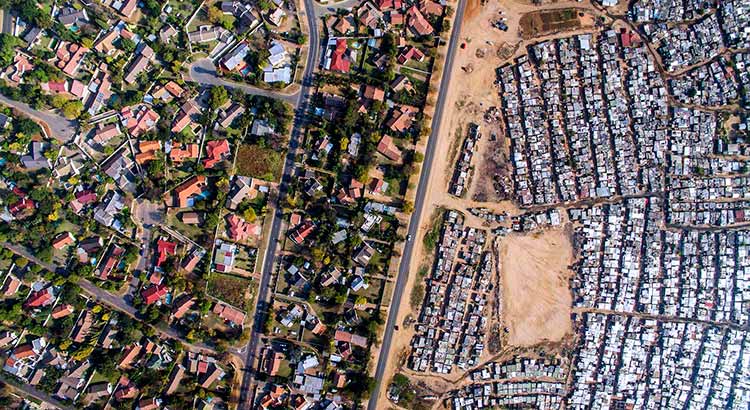
You can't have low inequality by definition if you decide to start paying one group a ton of money.
Well, this is a lot like the housing conversation in the US. "I want my house to go up in value, and be a great investment!" Also: "Why can't I afford a house?"
You can't have your cake and eat it too.
It's not necessarily a failure, it's just a different place to draw the line on social contract. While individual contributors earn less the social safety net also makes it much easier to found and grow a business without the threat of death and guarantees a peaceable minimum standard of living. It's also worth pointing out that salary, especially at high seniority levels, becomes a smaller and smaller part of total compensation.