North of Jasper but closer to the sea, and right next door to Alaska. Interesting spot but be prepared to add substantial cost of transportation to every molecule you may require.
Applied for what? The web site looks mostly like "Yo, politicians, you really should build a pipeline here to my empty town." What is there to actually apply for?
AKA real-life Bioshock 1 sequel/DLC without the superpowers. Remote location (check); next to the ocean (check); owned by a corporate/millionaire bringing in like minded people (check and check).
Sad to see libertarianism conflated with anarchism. The existence of a state, that does not violate people's rights, is perfectly consistent with libertarianism, and is arguably essential to it.
"I'm not going to argue against what you say you believe, I'm going to assert you believe something else and attack that, or group you with people who believe differently than you and argue against that."
Yeah read the blog post, that's by design--the town was abandoned in the 80s and has been maintained by a private owner. I think it would be kind of cool to live there as an escape from the hustle and bustle of cities. Like living in a shack in the woods, except the shack has most of the amenities of modern life (circa 1980).
I think that's missing the point by a hundred miles. Once you bring in Starlink, it becomes like any other place, just remote. Try moving there and living like in the 80s - without internet. That would be the appeal I think.
I think you are right. It’s weird though, that arm above the table doesn’t look like it has an X-ray tube on it, but the little control room appears to have a generator in it.
Strange to have chairs in the room.
Minor correction, it would usually be a radiographer not a radiologist who took x-rays. However if this was a screening room (a room that does imaging with a fluoroscopic unit), it would usually be a radiologist who did it.
I was wondering if I had mixed up radiographer and radiographer.
The chairs are definitely interesting. I can't think of any rooms like that where family or friends have been allowed. Maybe we're both right and it's a multipurpose "hospital" room? Might make sense for a small town that needs a doctor's office with basic exam capabilities.
> There are four occupant ready apartment buildings complete with 96 furnished two and three bedroom units. An additional 60 apartment units will be available for occupancy. All apartments are serviced by the town's water, electric and sewage systems.
> There is an office with phone, fax, internet, and photocopier facilities. We have an industrial kitchen with all appliances and a dining room that can seat 60 people. [0]
The answer to internet facilities seems to be "exists", but no more detail than that.
The last time I lived in similar level of remoteness, we had access to a single 15/5 satellite connection that was then split between all residences. It wouldn't surprise me if that was also the case, here. Starlink may also be available, and it's pretty much guaranteed to be faster than anyone else.
Out of curiosity I looked it up on a map [1]. It appears two of the closest settlements [2],[3] are also ghost towns or otherwise pretty much abandoned. Kind of nice to know there are habitable but uninhabited places left in the world.
If you follow the inlet back to the ocean a short ways, you reach Gingolx (Kincolith) [1] which has < 400 people. It would be a fairly unremarkable place except they randomly started having a big festival called crabfest, which has brought bands such as Trooper, Tom Cochrane, and Nazareth to this tiny village.
If one looks at the area of the Discovery Islands and other places in BC there is a lot of uninhabited area. If you go north on the island highway from Nanaimo BC on Vancouver Island the population density and town size starts getting small pretty quick. BC is huge.
Hell, go take a look at the Northern Territories and almost all of Northern Canada. You can even Street View the entire drive from Dawson City in the Yukon to Tukoyatuk, basically as far north as you can go. It's beautiful and eeeeeeempty.
Edit: I suppose I missed the part about a locale being "habitable but uninhabited". The Northern Territories aren't very inhabitable, but I still find the vastness absolutely fascinating at any rate.
There were plenty of towns set up purely for ruthlessly exploiting resources and then when the resources were gone the town closed up. On the coast these were often whaling towns or salmon fishing canning towns. In the interior it was mining.
Barkerville is an extremely well preserved olde gold rush mining town and well worth a visit if one visits the interior of BC. https://www.barkerville.ca/
I live in Iowa. Moved out here because I wanted to see what sorts of uninhabited-but-habitable places I could move to. The US Midwest has a lot of them if you're willing to poke around LandWatch.
Imagine if it was preserved as a historic model town, much like the Cultra Folk Museum, but for the 1980s instead of the 1940s. Some photos of that museum here:
It won't be long before the 1980s are as remote as the 40s were, and we wonder what life was like in a slightly more innocent time before the web and 9/11.
Also I am surprised that it hasn't featured in any 1980s films or series.
The house has so many design and decor cues from the house/neighborhood I grew up in in Redmond, WA. I wonder if there's a name for that design movement of orange carpet, wood panelling, wallpaper, linoleum, popcorn ceilings...
Yeah, this kind of split-level design was super common in the PNW and 1980s isn't even particularly old when it comes to housing (plenty of houses in the Seattle metro area that are from the '20s...).
Like here's a random listing from 30 seconds of searching that has light renovations: https://www.redfin.com/WA/Seattle/10201-23rd-Ct-SW-98146/hom... and if you spend enough time looking for "affordable" options in suburbs, it's not hard to find ones that have not been renovated since they were built in the '70s and '80s.
There's a common thing that I've noticed when going to Canada. As soon as you cross the border, you see tons of houses built in the 70s and 80s that are sided with stucco. They look so out of place in BC. In Washington, our climate is pretty much the same, but nobody here has stucco houses. I'm curious why so many up in Canada, but not here. They look like they would fit in nicely in Southern California.
Tons of houses in the 70s and 80s in Vancouver was built in the exact same style because of zoning laws and certain regulations at the time. I couldn't tell you why they chose stucco but they basically all follow the same template and they're basically a signature of the city now.
Not sure if this applies to houses built in the 70s and 80s, but I've heard that Chinese-Canadians have a strong preference for stucco over other forms of siding because it's perceived as being more durable.
Came to post this name. Yep it's a "BC Box." Very common in the suburbs of Vancouver built from the 70s through 80s. If you buy some random old house in Coquitlam or Langley in an "old" neighbourhood it's probably something like this.
So clearly the design was common throughout the rest of BC, even up north too!
Not just PNW, in the midwest where I grew up it was full of split level homes like that too. A bit more brick exterior but otherwise the exact same formula.
The Alaska Panhandle (the part of Alaska that extends down the west coast of BC) and the coast of BC are actually roughly equal length (BC's coast is slightly longer, I believe). You are probably looking at a Mercator projection which distorts sizes. Try looking at a more accurate map projection.
It exists cause Russia settled Alaska including a fort in the panhandle. There was treaty with British in 1825 that established the boundary of panhandle (but was very ambiguous for landward side). Russia then sold Alaska to the US in 1867. The landward boundary had to be decided in 1903.
There's no road along the coast, just isolated port towns, and there's a massive barrier of mountains and glaciers between it and BC, so on a human scale it's essentially not related to mainland Canada.
American politicians and capitalists realized how valuable the western half of the continent before British Canada did and they acted on it. If you look as the west coast it’s mostly American coast, it’s kind of surprising that Americans didn’t just take it all when you think about it
They did. The US’ Oregon Territory went well above the 49th parallel (current US/Canada border on the West coast), in fact all the way to where Alaska is today (southern most point on the coast).
The Alaskan panhandle was the subject of a border dispute between Canada and the United States. The UK adjudicated and it was decided in favour of the US. It was a very unpopular decision in Canada. https://en.wikipedia.org/wiki/Alaska_boundary_dispute
>Looking at the map I only just noticed how small the BC coastline is and how Alaska takes most of it.
Canada and the UK worried in the late 1940s that Newfoundland—at the time, planning to regain self-government after 15 years under British stewardship—would want to join the US, which the island historically has had the most commercial links with. Canada didn't have much trade with Newfoundland, but didn't want the US to essentially blockade its east the way Alaska already blockaded its west. Thus, when referendums were set up to give residents a choice of what to do, only the options of self-government, continued British rule, or joining Canada were listed.
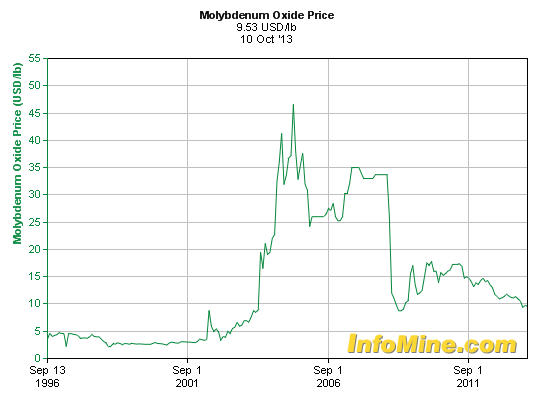
The price halving that killed the mine/town in the mid-1980s is barely visible at the very beginning. There was a massive price spike to above $10/lb around 2005, but it fell back to around $2 and has been pretty flat ever since. Production is reasonably evenly split between China, the US and Chile, so geopolitical risk is not huge.
Due to spherical geometry, Prince Rupert is closer to Asia than any other reasonable North American port (sorry, Skagway) south of Anchorage. Kitsault is just up the inlet, and much easier to reach (crossing the Coast Mountains sunk Prince Rupert). It also happens to be easier (lower) to cross the Rockies (CA-16) when you're north of Prince George, so Kitsault could possibly have better access to Chicago than does, say, Seattle (I'm not certain here).
However, the col to access Kitsault from the BC central valley is still about half a mile high, so you would need to build a tunnel to get decent rail freight capacity. It would be a short one, easier than tunneling to Stewart/Hyder. Also, the inlet is only about 1800 feet wide, which could be difficult to navigate considering the high frequency of inclement weather in the area.
There's rail access to Port Edward (just a couple miles from Prince Rupert) currently, going by what you can see in Google Maps. Looks like it follows a pretty flat route, though it winds around to follow the shorelines / rivers.
I wonder how much sea level rise or flooding it would take to inundate that rail line and the Yellowhead highway? They seem like they're barely above water level now.
Using Kisault as a port is an interesting idea. Worth mentioning that the tides in that area are huge, which makes for dangerous currents.
(Random personal trivia: I once passed within about 20 miles of Kisault while travelling to the Queen Charlotte islands by way of Prince Rupert. The 800 passenger ferry we took, The Queen of the North, some years later got off course on a different route and struck a rock at full speed and sank. Almost everyone got off.)
In the end there was no hard proof. Two people died, bodies never found. The officer was convicted with a four-year jail term (I’ve no idea how long he actually served.)
>There's rail access to Port Edward (just a couple miles from Prince Rupert) currently, going by what you can see in Google Maps. Looks like it follows a pretty flat route, though it winds around to follow the shorelines / rivers.
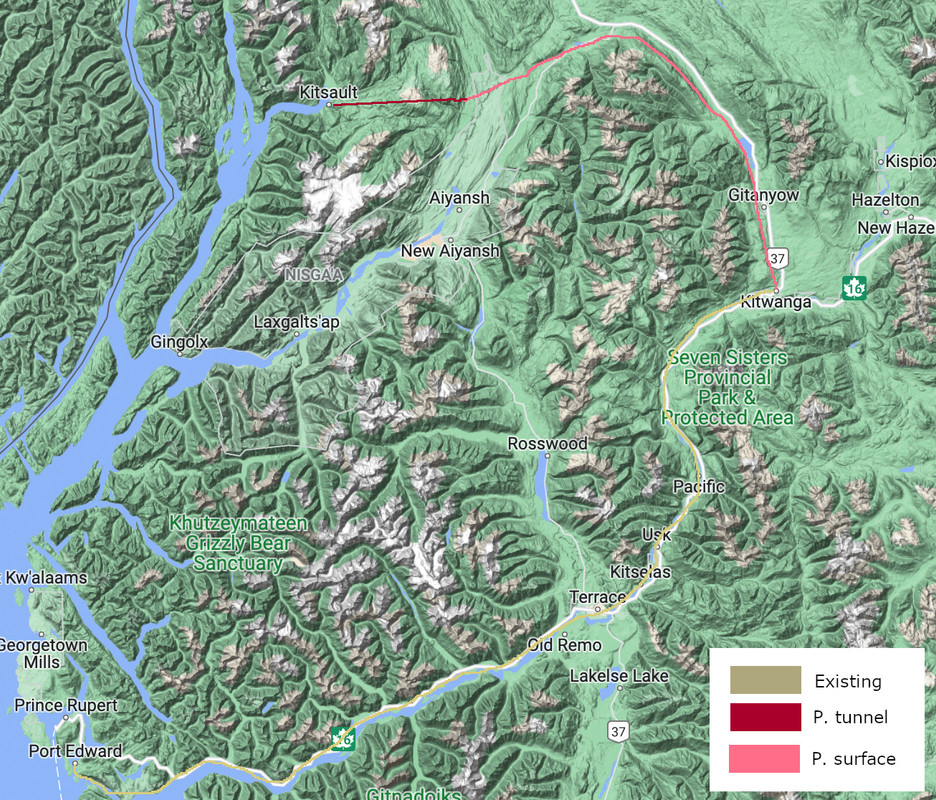
There is a railroad, but that is a windy, two-track railroad for the last ~200 kilometers from Kitwanga to Port Edward, with associated capacity limits and costs. To reach Kitsault from the relatively wide, flat Nisga'a Highway corridor, you need a tunnel of about 25 kilometers, but this could fit four or more tracks and run a much straighter, faster course. You can clearly see the difference:
The inlets around BC's coast are certainly treacherous and that's been a source of controversy around the various LNG and oil pipeline projects as depending on the site it seems inevitable that someone is going to sink.
I recall some company got in some controversy because during a public information session they had maps where they'd straight up removed many of the islands and shoals from the maps of the inlet.
Canada likes to ship its oil out that way, esp to Asia.
Pipelines from Alberta to BC are a political minefield but buying real-estate and then waiting for the politics to “blow-over” is apparently a thing that happens a lot.
If you're referring to Northern Gateway, it was planned to terminate in Kitimat, which is not a ghost town. However, tanker traffic off the BC north coast was banned, which effectively killed it.
If you're referring to Trans Mountain, that pipeline upgrade/expansion terminates in Burnaby, which is a suburb of Vancouver.
For other interesting company-owned ghost towns on the coast, see also Anyox and Ocean Falls. Anyox is relatively close to Kitsault and is worth reading about: https://en.wikipedia.org/wiki/Anyox
There's also Stewart, which is north of these and which has quite a storied mining history that's still being written (the "Golden Triangle" of BC).
McElroy is a specific name that originated in two small geographical regions with tightly tied genetics and the two Justins bear a strong resemblance.
Most Scotch-Irish people in Canada are related in some way because the initial colonizing wave was quite small. The podcasters are from Milwaukee which shares a border with Canada, is near Canada's most populous city, and was largely settled in that same small wave.
Asserting that they're "no relation" would be quite a stretch.
Okay, but if someone asks if you have any relatives in town, you probably don't need to mention that technically everyone is related. You definitely don't need to also mention that the geese are also distant relatives.
These is something perversely funny about setting up for a future that’s worse, rather than trying to fix the situation. Obviously it’s easy to control what a few people do over what a few billion people do.
Hmm well that seems to be the problem. A shame it wasn't allowed to grown on it's own and then maybe something would have come of it... Weird that it's private property, that is a bit creepy.
Nearby (13 miles), is another ghost town but much older and destroyed. It's called Anyox and has a beautiful Eastwood buttress arch dam. I toured the area 15 years ago or so and it was fascinating. Beautiful scenery as well.
yeah, I recently watched a youtube video about that town, looks pretty interesting. And the guy seems to have a few more videos from other abandoned towns in BC too...
https://www.youtube.com/watch?v=p7PVZq-lqCs
>Not only a ghost town, but a ghost town that was built for $50 million in 1981...
>It is a long way from any major city, and not accessible by road...
Edit: From Wikipedia...
>In 2004, the ghost town was bought by Indian-Canadian businessman Krishnan Suthanthiran for $5.7 million; he has spent $2 million maintaining the town.[2] In the end, he would have spent over $20 million more to fully update the town. He has also since closed the town to the public.
The author even mentions driving in "Which means, for a fee, you can drive two hours down a barely passable road. The caretakers will open the locked gates"
Yeah, I missed that detail, but it still helps my point - that it's relative inaccessibility is why it's so cheap. The town itself might not cost much, but accessing it, or making it more easily accessible, is going to come with a price.
You're right that it's a chicken and egg problem. The place needs some resource to incentivize jumpstarting that infrastructure and it's not clear what that would be.
There’s a surprising amount of undeveloped land privately owned even close to populated areas. On a recent tour of Stanley Park in Vancouver, the guide gestured at the mountainside to the northwest and told a story about how the Guinness family purchased it for $75,000 in 1931. As recently as 2015 [0], there were news articles talking about continued development of the 4,000 acres of land!
Interesting. Would love to visit some day, possibly during a trip to northern BC.
One thought I had after looking at the pictures is that... it really doesn't look that old/historic. I live in the PNW right now and a lot of the houses and public infrastructure still look just like this! Heck, I live in a '80s house that's still in original condition just like in the pictures...
It's neat to see one of my personal holy grails of urban exploring being posted here and then see people talking about gentrifying an entire preserved town from the 80s to build some kind of weird techbro commune. Never change HN.
I get the disdain for gentrification when it displaces existing communities.
I have a harder time seeing the harm in finding a productive use for a city that currently doesn’t have a productive use. It’s cool that this place exists, and is a bit of a time capsule. But it’s not that noteworthy or valuable beyond being a mild curiosity, and certainly not worth preserving if it can be used for actual benefit instead.
I always thought part of the appeal of urban exploration and abandoned sites was the knowledge that abandoned places get redeveloped, and the fun is in exploring it before it gets turned into something new and shiny. Artificially preserving a place that could have another use takes it from “urban exploration” to visiting a museum, which is much less cool
It's mostly local opposition, it wasn't really popular within the city and Google was horrible at trying to communicate what they really wanted to do with that place. At the end of the day, giving so much power to develop a part of the city to a private entity was weird.
Rant: Please give-me real links to images. I love ctrl-clicking them and then later looking at them on the open tabs. This clicking an image and having a modal overlay prevents me from reading the text.
"Please don't complain about tangential annoyances—things like article or website formats, name collisions, or back-button breakage. They're too common to be interesting."
BC in the 80s, 90s seemed like completely different worlds compared to today. Vancouver especially seemed to have peaked early 2000s before the housing bubble took off. Rainforest Cafe, Playdium, Indy 500, Vancouver Grizzlies, Canucks.
It had so much going for it. What was once a fun, soulful city is now something completely different.
BC was altered considerably by a series of economic crisis in the 90s; notably the softwood lumber dispute, the opening of raw log exports, the salmon fishery dispute, and the asian economic crisis. All told, they had the cumulative effect of shifting BC's economy away from lumber and fisheries and toward tourism and real estate.
The criminal government from 2001- 2017 did not help matters. Money laundering so extensive that it begot its own name (the “Vancouver Model”). It completely fucked the housing market.
The current government's investigation found no sign of criminal collusion at the government level. It also found that money laundering had barely any influence on housing prices.
Wilful Blindness by Sam Cooper provides endless evidence that the government is corrupted. “We investigated ourselves and found that we are not corrupt” is not a ringing endorsement. Money is power and in BC the criminal GDP is as valuable as any of our legitimate business sectors, like fishing or forestry.
It was an NDP-Government led investigation; so it wasn't a case of the accused investigating themselves. If anything, the NDP had incentive to discover malfeasance.
The Achilles heel of Vancouver was the insane liquor licensing, which lead to the moniker of "No Fun City". That's what you get when your city is founded by a bunch of Scottish Calvinists.
But otherwise, I have great memories of my early 20s seeing bands at the Niagara Hotel and hanging out three nights a week at the Ivanhoe while paying $500 a month for a decent studio in the West End. Commercial Drive was in full swing as a sort of '90s Haight-Ashbury. Now all those places are gone and the city feels sleek and generic, like a cut-rate Hong Kong.