That's a huge misrepresentation of what happened to SimCity. EA released a incredibly user-hostile version of SimCity (always online, microtransations and more) that almost no one liked, and Cities: Skylines was released around that time too.
I bought both when they came out, and the user hostile stuff didn't bother me at all. What killed sim city was most definitely the performance issues. Unless they had a better reason for restricting the maximum city size.
And then the fact that skylines had both a larger play area and more fancy city building features was just the killing blow.
EA got caught out, thinking they could leisurely bring out an inferior product, when a competitor emerged guns blazing.
Yeah, the user-hostile DRM stuff was really just the icing on the cake. people regularly tolerate all that same stuff when the game is actually good. but when the game is shit, it makes it really easy to take a pricipled stance that you're boycotting the game because of DRM.
> Unless they had a better reason for restricting the maximum city size.
They did! EA wanted you to play the game online. They encouraged you to connect your city with other players by making it difficult for cities to be self-sufficient.
SimCity 4 was the last of statistical city simulators. That is to say, if you put down something like a distressed Ong Condos, the game would go "okay, here's 20,778 people in this node in the transportation network, do some network flow and figure out where they work." Newer titles, including the ill-fated SimCity (2013), are agent-based, where they essentially drop in a person and tell them to figure out where they can go or something like that.
As for why SimCity (2013) was a series-ending failure, it was essentially that at every single juncture, EA choose the stupidest possible option, the one that would most guarantee the failure of the series.
The first failure was in the engine itself. AIUI, the developers who came up with the modeling engine knew it wouldn't scale, and never intended for it to actually power a full-fledged SimCity mainline title. EA decided to tell them that it was going to be that anyways. The simulation just didn't scale; the desultory size of the cities was meant to prevent people from attempting to build anything that would cause the simulation to keel over and die--although it's also clear that the max size limit still was too large for the simulation. This is probably where you're getting your idea of perf issues from.
The most famous issue, though, is EA's requirement that the game have multiplayer features to justify being always online (and thus having more intrusive anti-piracy checks). SimCity doesn't lend itself well to multiplayer functionality, and many people correctly assumed that it was a gimmick to justify anti-piracy. Bizarrely, EA tried to claim for a while that one advantage of always-online was to be able to use more powerful servers to do the simulation calculations, but this was never implemented, and the lie was discovered extremely rapidly.
But the single stupidest decision was that EA never put in place enough server capacity to handle the launch. The game would be EA's first always-online flagship release, which meant it would strain their capacity like nothing else they had released ever did. The lack of capacity was repeatedly highlighted as a potential issue in prerelease, and yet was repeatedly ignored. Problems were reported during beta testing and the press preview period, and were still ignored. And launch day came, people experienced several issues, and it still EA like a few weeks to begin to address the issue.
Oh, and you can't forget all the other regular video game release issues like games being released because they need a release date rather than because they're done and things like that.
>SimCity doesn't lend itself well to multiplayer functionality
You make a lot of great and accurate points (including blaming EA instead of Maxis). But I disagree that SimCity doesn't lend itself well to multiplayer functionality. (And perhaps EA isn't the right company to pull it off properly, being more focused on competition and violence than collaboration and education.)
I agree that it would be difficult to adapt SimCity to competitive play without over-complexifying and spoiling it, but SimCity is ideal for collaborative play, and constructionist education (as envisioned by Seymour Papert and Alan Kay)!
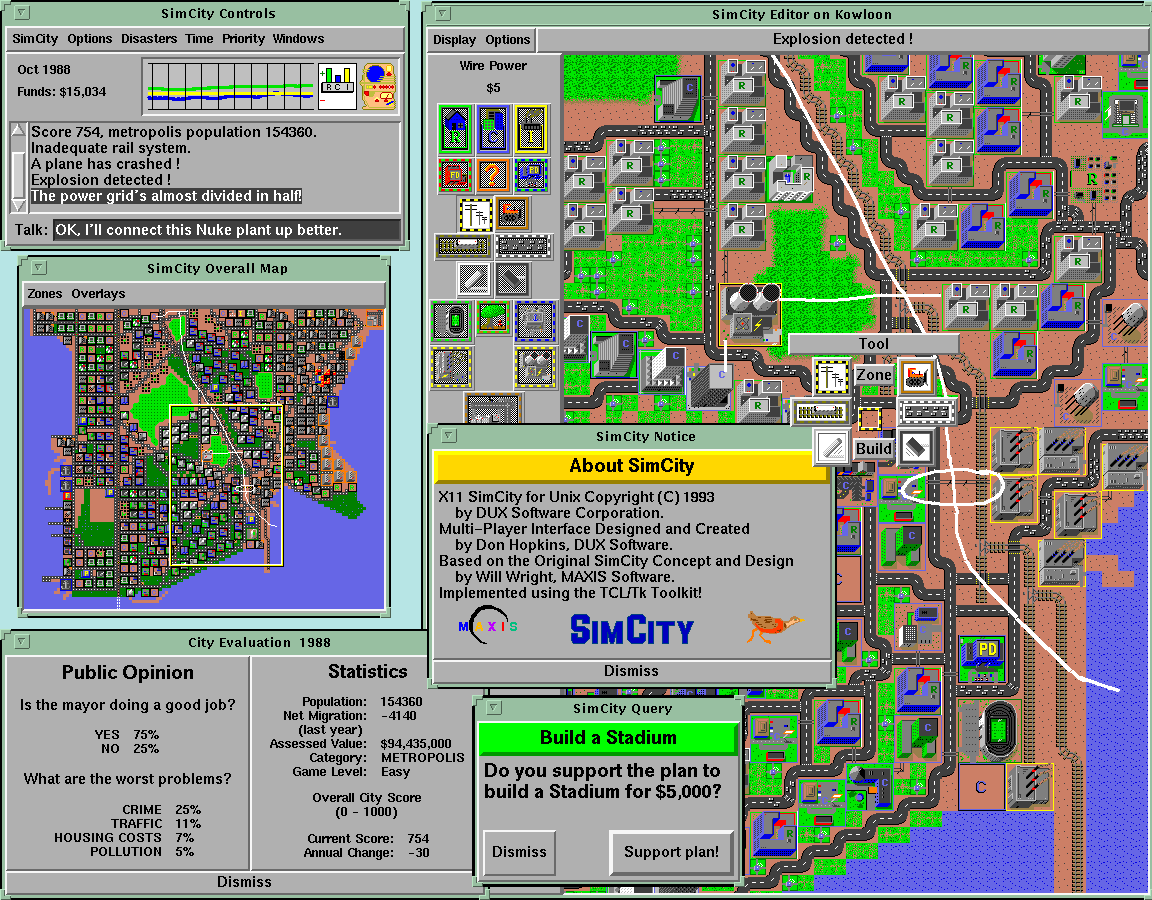
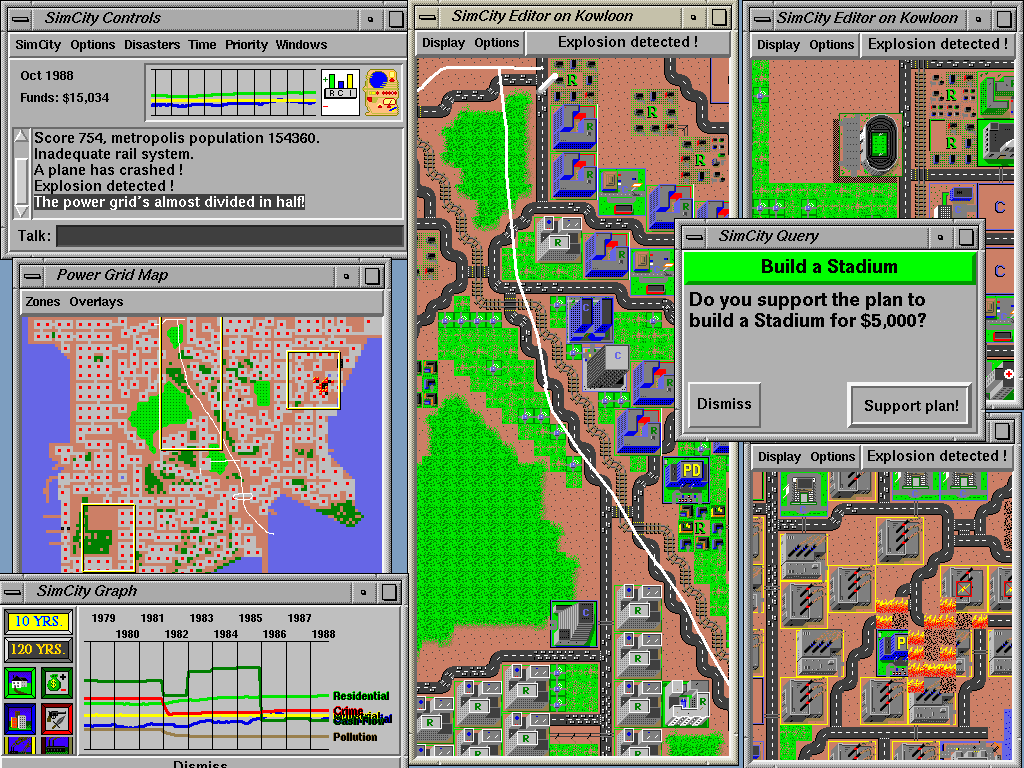
I designed and implemented a collaborative multiplayer version called SimCityNet that I released online in 1993 (with node locked and floating DRM, but that worked offline or on a private network), including text chat and shared whiteboard overlay and voting dialogs and pie menus, which I described in my other post:
Back when ActiveX was a thing, Mike Perry at Maxis produced a web browser plug-in version of SimCity that was simply integrated with a text chat window, so although you were playing your own local copy of SimCity, you could chat with other users playing their own cities in their own browsers, brag and gossip about your city, ask questions and help each other. It was a huge hit relative to the amount of effort it took to implement, and despite its clunky stripped down user interface, but it demonstrated how essential and engaging communication between players was, even if they couldn't actually affect each others games or share save files.
>Meanwhile SimCity Classic did not die: Maxis/EA has transformed it into a Web game you can play from your browser (after registration). The Web SimCity plays just like the computer game, except that it does not have every feature. Also, since the game is an ActiveX control, you must use Internet Explorer to play it.
I also designed and produced two different educational versions of SimCity/Micropolis, one an OLPC XO-1 Laptop interface for kids (X11/Cairo/PyGTK/Sugar) and one a web client/server interface (Python/TurboGears/AMF/OpenLaszlo/Flash) for an online community around shared multiplayer games and a storytelling platform. I completed MVP first-cuts, shipping the single player X11 version on the OLPC, and a web interface supporting multiple players sharing simulations running on the server.
I haven't fully completed the long term plans for the web based version, because Sugar never panned out then Flash died, and I didn't have the resources or support.
Finding support for developing educational software is tough, and I'd rather contribute new stuff to a truly free open educational community inspired by Seymour Papert's philosophy, like Snap!, than sharecrop on EA's intellectual property.
I believe Seymour Papert's collaborative constructionist educational ideas can be applied to other city simulators, many other types of games, and especially visual programming environments like Snap!
It's fortunate that SAP supports Jens Mönig to continue building on top of the block based visual programming ideas that he, Brian Harvey, John Maloney, Yoshiki Ohshima, Alan Kay, the MIT Media Lab Scratch project, and others developed:
    Notes on adapting Micropolis to the OLPC Sugar user interface:

    Core Ideas:

      Activities, not Applications

        First cut:

          Integrate the current TCL/Tk version of Micropolis to run as a simple activity within Sugar.

            Restructure the multi-window TCL/Tk code to run in a single full screen window.
            Implement a simple activity-oriented tiled window management interface.
            Disable advanced features like multiple editor and map windows,
            that require more sophisticated window management.
            Instead of using a traditional multi-window management approach,

            Make a simple wrapper around it that makes it appear in the Sugar user interface as an activity, like eToys does.

          Long term:

            Implement activity specific modes that reconfigure the user inteface (like Eclipse "perspectives").
              - build/edit oriented interface
              - query/analysis oriented interface
              - financial oriented interface
              - communication/coordination oriented interface
              - dynamic zone finder analysis
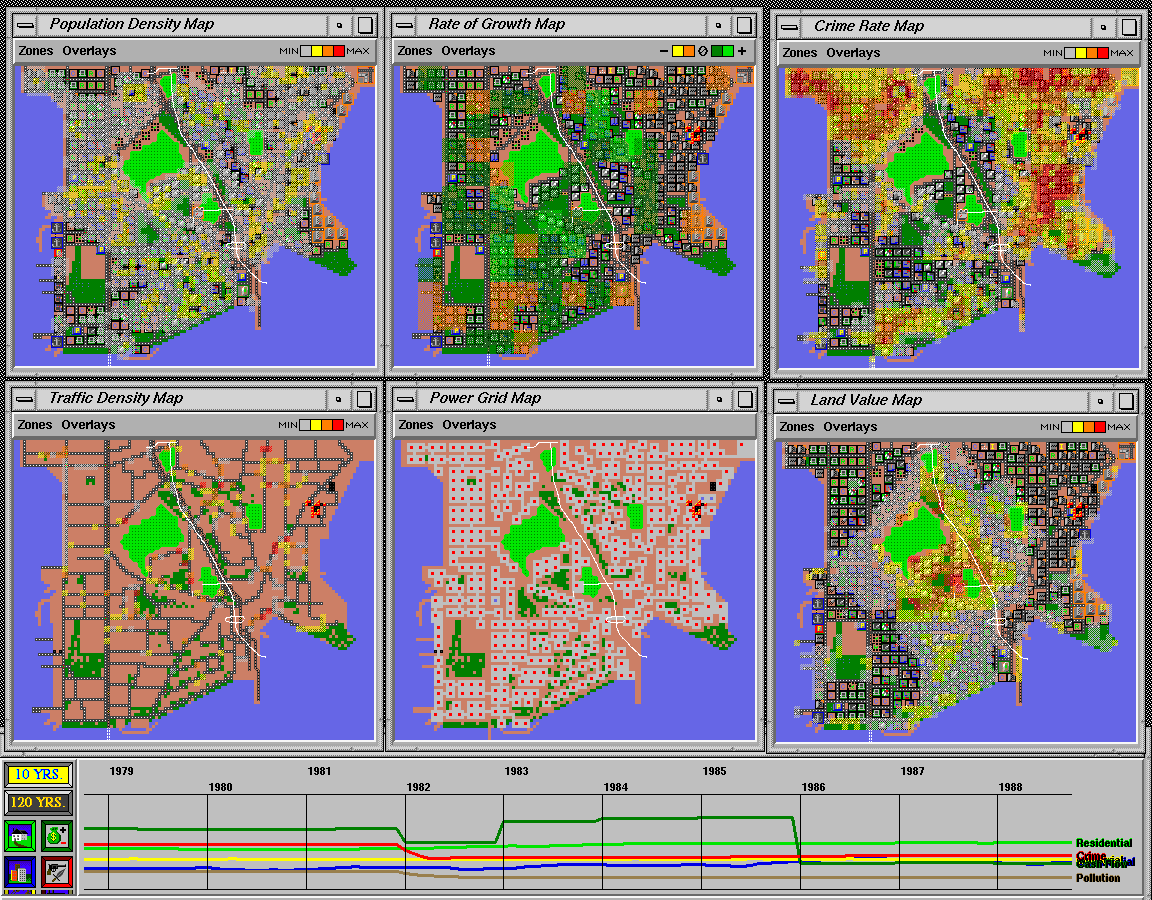
              - grid of several overall map views, each configured to show a different overlay.
              - grid of several close-up map views, each centered on a different parts of the city (or tracking a player's cursor)

            Collaboration: Enhance multi player mode to support sharing activities.
              Both publishing your game for others to clone and play themselves (massively single player, like Spore),
              and letting others join in your game (like the current cooperative multi-player mode)).
              Multi player inte

            Expression: Enhance chat, journaling, storytelling, and personalization aspects of the game.

            Journaling: Record all events (both user edits and simulation events), chat messages and drawings.
              Checkpoint the game state, and implement the ability to deterministically replay time stamped
              editing events into the simulation, so you can fast forward and rewind from any checkpoint to
              any step of the simulation.
              Enable players to write newspaper articles about the cities, with live links to a snapshot
              of the simulation and a place on the map, related to the story. Other players could browse
              their published newspapers about the history of a city, and jump into that history at any time
              from any story.

            Iteration: Checkpoint game save files, allowing players to rewind history, and try "what-if" experiments.

      Presence is Always Present

        First cut:

          Enhance the current X11 based multi player interface to support presence, the grid network, and messaging.
          The current multi player interface runs a single Micropolis process on one laptop,
          which connects to the local X server, and/or several other X servers on laptops over the net.
          Rewrite the "Add User" dialog to be grid-network aware.
          Instead of asking for an X server DISPLAY screen, provide a list of friends on the network.
          Send an invitation to play to friends on the network.
          Rewrite the built-in chat interface to integrate with the chat system used by Sugar.
          Improve the shared "white board" overlay, so kids can draw on the map in different colors,
          enable and disable different overlays, save overlays with the map, add text to overlays, etc.
          Implement location based chat, by overlaying people icons and chat bubbles on the map.
            Each player has a people icon "cursor" that they can move around the map (which follows
            their selected editing cursor), and their chat messages show up in bubbles overlayed on the map.
            When you select an editing tool, you can type what you're doing with the tool,
            other people will be able to watch you, and make comments on what you're doing.

        Long term:

          Rewrite Micropolis in terms of Python/GTK/Cairo, and take full advantage of the Sugar libraries and services.
          Support sharing, mentoring, colaboration, voting, political dialogs, journaling, etc.
          Develop Micropolis into a exemplary, cutting edge demonstration of all that's great about Sugar.

      Tools of Expression

        Micropolis is great at supporting personal expression, interpretation and storytelling,
        and leveraging what the player already knows to make connections to new knowledge,
        and stimulating conversation, debate and analytical thinking.

        Develop a web based "Wikipedia" oriented interface to Micropolis, supporting colaboration, discussion,
        annotation, history journaling, and branching alternative histories.

      Journaling

        The "Micropolis Journal" could be realized as a web-based
        newspaper-like interface.

        Expose the multi player user interface through the web, instead of
        using X11.

        Automatically generate a newspaper for any particular time in a
        city's history, from the simulator events and state, combined with
        user written articles and chat messages.

        The newspaper has sections that present automatically generated
        snapshots of the information displayed in the various dialogs
        (graph, evaluation, chat, notices, etc), and stories about
        significant events (both user-generated and simulation-generated).

        Enrich the city save file with metadata including the chat and
        event journal, overlays, snapshots at different points in time (in
        a branching "what-if" tree structure), etc.

        In the Python version of Micropolis it will be easy to implement a
        web server based interface that lets users read the city's
        newspaper through the web browser, automatically inserting
        pictures of the map corresponding to particular events in time. An
        article about pollution going down could show a before and after
        overall map with the polution overlay, and stuff like that.

        Plug in modules to the simulator that analyze the state of the
        city and generate events for the newspaper to write articles
        about, including interesting stastical information and other
        parameters to insert into the story template.

        Implement "online surveys" that let newspaper readers vote on proposals
        (expose the voting interface to web based users).

        Use OpenLaszlo to develop a rich graphical AJAXian web service
        based Micropolis interface, eliminating the need for the X11
        interface, and enabling all kinds of interesting interface
        customizations and mash-ups with other web services.
Here's a proposal I wrote to Maxis in 2002 asking to license the rights to develop a commercial educational version of SimCity for Linux, based on the multi player Unix version, with the support of Columbia University. They didn't bite at the time, but Will Wright and I eventually talked them into actually making it open source in 2008:
>Educational Multi Player SimCity for Linux Proposal
>Submitted by dhopkins on Sat, 2004-02-07 14:27. C Cellular Automata Pie Menu Applications SimCity TCL Game Design
>Back in March 2002, Maxis told me they were interested in supporting the educational use of products like SimCity. Earlier, I had developed a multi player version of SimCity, which runs on Linux/X11, and was scriptable in TCL. Educators and researchers from Columbia University, MIT, IBM, Xerox and other educational and commercial institutions were excited about gaining access to this version of SimCity, and adapting it to teach and stimulate students' interest in urban planning, computer simulation and game programming.
>So I wrote this proposal and presented it to Maxis, but nothing ever became of it. But recently, Will Wright has been pushing EA to relicense SimCity under the GPL, so the OLPC project can use it. So it may eventually see the light of day!
I don't recall performance problems being the main concern for the last (final) Sim City, but I won't say you are incorrect. What I do remember is
1. shallow game play compared to its predecessors
2. demand for always online and proven lies about offline play not being possible because of the game architecture
3. invasive DRM, during a time when invasive DRM was on everyone's mind
4. launch issues which, combined with the always-online requirement, meant a solid "plop" of a release.
5. EA was already negatively viewed at the time by many PC gamers
It looks like the wikipedia article for the game mentions some of these, and other issues.
> SimCity's sixth major release was announced on March 5, 2012, for Windows and Mac OS X by Maxis at the "game changers" event.[31] Titled SimCity, it was a dramatic departure from previous SimCity games, featuring full 3D graphics, online multiplayer gameplay, the new Glassbox engine, as well as many other feature and gameplay changes. Director Ocean Quigley discussed issues that occurred during the development of the title, which stemmed from two conflicting visions coming from EA and Maxis. EA wanted to emphasize multiplayer, collaborative gameplay, with some of the simulation work conducted on remote servers, in part to combat piracy. In contrast, Maxis wanted to focus on graphical improvements with the new title. Quigley described the resultant title as a poor compromise between these two objectives- with only shallow multiplayer features, and a small city size limit- one quarter of the land area of previous titles in the franchise.[2][32]
> The game was released for Windows on March 5, 2013, and on Mac in August.[33][34][35] Medium would later refer to the release as "one of the most disastrous launches in history".[2] The game required a constant internet connection even during single-player activity, and server outages caused connection errors for many users. Multiplayer elements were "shallow at best", with departing players leaving abandoned cities behind in public regions. Users were unable to save their game- with the servers instead intended to handle this- and so when users were disconnected they would often lose hours of progress.[36] The game was also plagued by numerous bugs, which persisted long after launch.[37]
> The title was heavily criticized in user reviews, and developer plans for post-launch updates were scrapped.[2] EA announced that they would offer a free game from their library to all those who bought SimCity as compensation for the problems, and they concurred that the way the launch had been set up was "dumb".[38] As a result of this problem, Amazon temporarily stopped selling the game in the week after release.[39] The always-online requirement, even in single play, was highly criticised, particularly after gamers determined that the internet connection requirement could be easily removed.[40] An offline mode was subsequently made available by EA in March 2014, and a mobile port entitled SimCity: BuildIt was released later that year.[41][42][43]
> It has been suggested that the poor performance of SimCity was responsible for the 2015 closure of Maxis' Emeryville studios, and the end of the franchise.[44][45]
indirectly. i'd say the largest single early complain about simcity 2013 was the small maximum city size you quote, which people attributed to perf-related restrictions
SimCity wasn't just "DRM heavy", it was totally unplayable for the first week after the launch because a ton of people were trying to play it at the same time and being stopped by its overloaded DRM servers.
And the name of the DRM was Origin. It was all about some EA executive deciding to force Origin down everyone's throat, and using SimCity as the Astroglide.
No, I have been working with SimCity since 1991, when I developed and in 1993 distributed online an actual multiplayer version of SimCity for X11 myself (it even had "node locked" and "floating" DRM, but worked fine offline or on a local private network, like when I showed at the ACM InterCHI '93 conference in Amsterdam, but of course I removed the DRM for the open source educational OLPC and "Micropolis" web based versions in 2008). So I know and worked with the people involved at Maxis and EA, and they told me the inside story of what actually happened at the time.
Multi Player SimCity for X11 is now available from DUX Software!
It was all about EA wanting to roll out Origin as their online distribution channel like Steam, and Origin wanting SimCity to be the showcase product that they used to force people to install the Origin downloader in order to play SimCity, and the stubborn insistence that SimCity be "online only" as DRM, and refusal to admit it was a mistake and fix it in response to user demands, all came 100% from Origin, and was forced on Maxis against their will and better judgement.
Then Maxis senior VP Lucy Bradshaw had to take the public flack for that, fall on Origin's sword, and make the false announcement that SimCity wouldn't work offline, even though she opposed it and knew it was bullshit.
And the server meltdowns were all Origin's fault, because they simply didn't have their shit together.
Lucy's a good person who was put in a shitty position by EA management, and she and Maxis and Emeryville Studios and SimCity players and the franchise itself all got screwed and suffered because Origin fucked up, and insisted Lucy and Maxis publically take the responsibility and consequences for Origin's idiotic and stubborn mistakes.
So I wouldn't be shocked and surprised if Cities: Skylines 2 problems with production and shipping before it was ready had more to do with Paradox than Colossal Order.
>It has been suggested that the poor performance of SimCity was responsible for the 2015 closure of Maxis' Emeryville studios, and the end of the franchise.[44][45]
>Bradshaw became senior vice president of Maxis in 2013, after serving as the studio's general manager.[5] Bradshaw oversaw development of SimCity, The Sims, and Spore.[6][7] She encountered controversy due to technical issues with the 2013 reboot of SimCity.[8][9]
Maxis explains what went wrong with SimCity and what the developer is doing to fix it: